


28 Jul 2025
Defying drought to make the 2025 World Rowing Under 23 Championships reality
If you’re at all familiar with Lake Malta in Poznan, you may have noticed from the 2025 World Rowing Under 23 Championships livestream and photographs that it is looking a little less full than normal at the moment.
Every four years the lake, which is an artificial reservoir on the Cybina river, has to be drained for maintenance work. This year is one of those years, but due to an unprecedented dry winter and the lowest water level in 50 years in February and March 2025, the refilling process has been more of a challenge. The current depth is around 250cm, about a metre less than usual.
“Usually it takes six weeks to fully achieve the target, however this time in April we realised that it was taking a lot longer,” explains Alexander Daniel, the executive director of the Poznan organising committee.
“In April we had about one metre depth at the deepest point. We realised it might be a problem, especially because it’s the first time this situation happened in the 30-year history of this lake.”
In Poznan the main challenge with a lower water level is that the racing infrastructure – such as the start bridge, boating pontoons, and victory ceremony pontoon, as well as the main warm-up area – is all permanent and built of concrete. They can only be used when the water level is at least 350cm.
So at the beginning of April the organising committee first started to examine their options. They looked at the lakes upstream of Lake Malta, to see if they could pull water from those, but that was not possible.
They looked at the chances of there being a lot of rain to refill Malta naturally, but the forecast was for drought.
The next solution considered was ambitious – to pull water from the river Warta, which is about 500m from the regatta venue, using hoses and pumps belonging to the fire departments.
“However due to environmental restrictions, the wildlife in the river and all those factors, this scenario wasn’t possible at all,” Daniel says.
Collaborating with the local water company to pump water from other sources was also considered, and decided against. That left managing the situation, or cancellation of the event entirely.
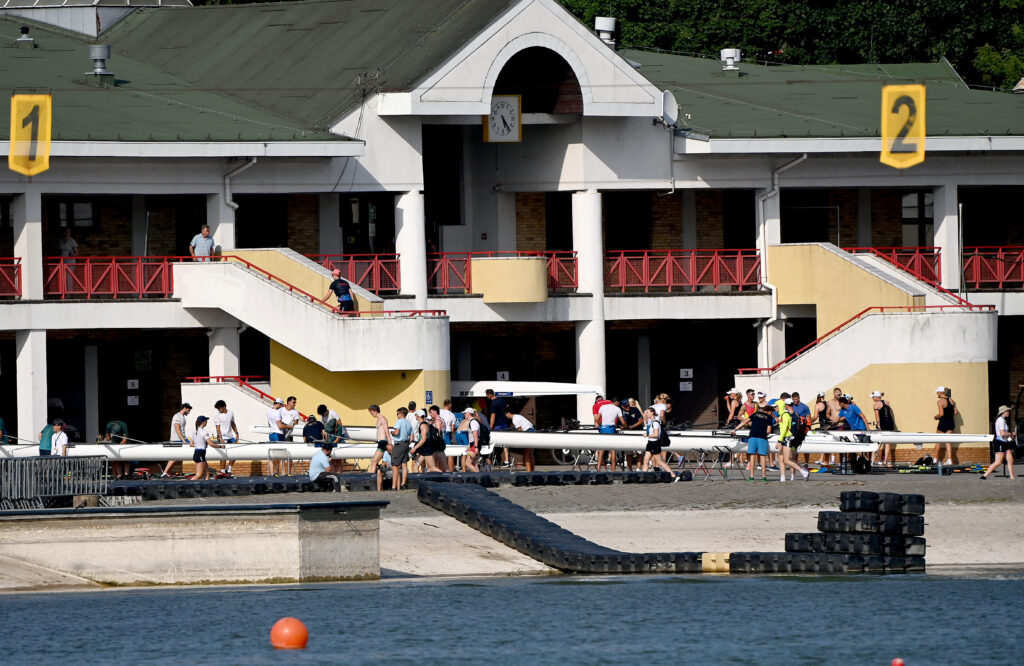
“At the end of April, beginning of May, after further talks with World Rowing we decided to conduct this event,” reveals Daniel. “We agreed to have at least 2 metres 20 centimetres of water to host this event, however even at this stage it wasn’t sure. We had then around 1m 20, so still one metre less. However there was also strong support from the World Rowing side that all compromises were possible, even if it was not easy for athletes.”
For a while, it was thought that racing would happen but over a slightly shortened course – 1980m instead of 2000m. Luckily, the water level did gradually rise and the infrastructure introduced has enabled racing to take place over the full 2000m, despite variations due to recent high temperatures and natural evaporation from the surface of the lake.
“Every bit of infrastructure at the venue was challenging. We didn’t have an idea how to do it, because it has never been done before here,” says Daniel. “It is easy to put a floatable pontoon if you have direct access to the water, but here everything is made of concrete, there are fences made of concrete. It’s not as if you can just go directly to the water.”
It also became apparent that the number of floating pontoons was enormous, but with experimentation the organising committee found solutions. Notably, the start pontoon is one long structure instead of having the usual ‘fingers’, to enable a 2000m course. Eagle-eyed viewers may have noticed that this has meant some boats have had to be held further away from the pontoon than others to align the bows correctly, but even the longest eights fit in the required space.
“Just one week before the competition, during the site visit by our technical delegate, we realised that it was necessary to build a temporary start tower, because from the existing one the water level is too low and the judge at the start cannot see all the athletes, especially the coxswains. So there were many surprises, every day. It was a really interesting experiment for us,” adds Daniel.
Despite the challenges, the organising committee and their army of volunteers have made the regatta happen. Daniel points out Poznan also hosted the 2020 European Rowing Championships in the middle of the Covid-19 pandemic, laughing: “We are hard-job specialists.”
The lesson for the future, he says, in a world of uncertain climate and weather, is not to host an international regatta in the year after the lake is drained.
“Right now we are happy it started, however we’ll be satisfied after the end because we’ll know that everything was fine and everything worked well,” Daniel says.
“If you have a lot of temporary infrastructure and a lot of new things you’re not familiar with, every day you don’t know what to expect. So you’re fully ready for any activity which will be needed to fix anything because every day something can happen. There’ll be full satisfaction at the end.”