


28 Jul 2025
Monday debrief: GOATS and goats in Poznan
The first of this year’s World Rowing Championships is over, after five days of frankly excellent racing in Poznan, Poland. Despite a few logistical challenges, the regatta showcased the best of the next generation and set the standard high for the under 19 and senior World Rowing Championships still to come.
The challenges
The Lake Malta regatta venue in Poznan has been used many, many times for international regattas and comes with an experienced organising committee and tons of permanent, quality infrastructure. The problem this year was that that infrastructure is all concrete, and due to a particularly dry winter, when the lake was emptied for its four-yearly check-up, it did not refill as quickly as usual. In fact, the lake was a metre lower than it would usually be, with the concrete sides looming high above athletes’ heads when they were on the water.
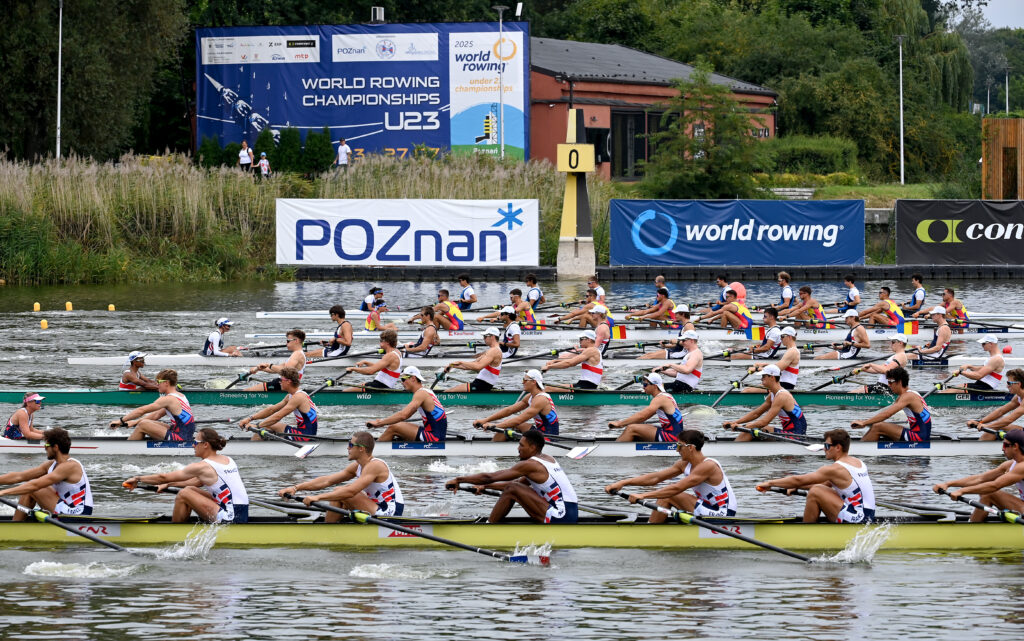
However, as soon as they realised there would be a problem, the organising committee swung into action and by the time crews started arriving had built temporary pontoons for boating from, starting from and picking up medals from, as well as a temporary start tower so the umpires could see the whole length of a boat. And apart from a bit less space for warming up and cooling down, the lower water level was not an issue in the end. Ironically it did start to rain in regatta week …
Huge congratulations have to go to the team behind the regatta to make the event happen so seamlessly in the face of the drought; sadly, due to climate change and the unpredictability of rainfall these days, there’s every chance they will not be the last organising committee to be faced with this type of challenge. But they proved that with a bit of ingenuity, obstacles can be overcome.
The wins
A particularly joyous note about the 2025 edition of the World Rowing Under 23 Championships was the sheer number of nations winning medals. A total of 22 reached the podium – 10 nations winning one medal, 12 winning at least two.
Germany went home laden with five silvers and five bronzes won by a total of 29 athletes. Great Britain picked up four golds, won by 26 athletes across both eights and the women’s four and quad. Italy won five medals – three golds and two bronzes.
Türkiye also won three gold medals, including their first wins in the openweight and lightweight men’s singles.
Austria and Denmark picked up their first-ever women’s sweep medals at under-23 level and Switzerland did the same for openweight sweep on the men’s side, with bronze in the men’s pair. Portugal’s Diogo Goncalves won his nation’s first openweight under 23 medal in the single.
The USA won the men’s four for the first time (just a year after they broke a 64-year drought in this event at the Olympic Games) – and also ensured an incredible run of 19 medals from 19 appearances in the under 23 women’s eight.
And while they may have finished well out of the medals, a shout-out to Somalia’s Abdirahman Hassan and Malaysia’s Kheng Aik Ong. Hassan, who has been rowing only a couple of years and sculling since November, is Somalia’s first-ever international rower at any regatta anywhere; Ong is Malaysia’s first under-23 representative. Let’s hope they pave the way for more representation from their nations.
The GOATS
Poznan’s mascot is the goat, after the two mechanical goats which form part of the town hall clock in the city’s central square. Appropriately there are some athletes whose performances in Poznan this year make them among the GOATS (greatest of all time) at under 23 level.
Chief among these is Switzerland’s Aurelia-Maxima Janzen. The sculler has now completed her world under 23 career, as she turns 22 in December, but she leaves with one of the most impressive resumés of all time. With two gold and three silver medals, she ties Kendall Chase (USA) as the individual with the second-most under 23 medals in history. Only Italian coxswain Filippo Wiesenthal has more (six).
Also racking up the medal count in Poznan was Great Britain’s Harry Geffen. Geffen also ages out this year, but has become the first male rower to win four gold medals, and the first under-23 athlete to win four consecutive gold medals. With titles in each of the three sweep classes, Geffen has also shown his versatility.
Ones to watch
While Janzen and Geffen must now look to senior events for their rowing futures, there are other athletes who made their debuts in Poznan who have plenty of years left at under 23 – and even under 19.
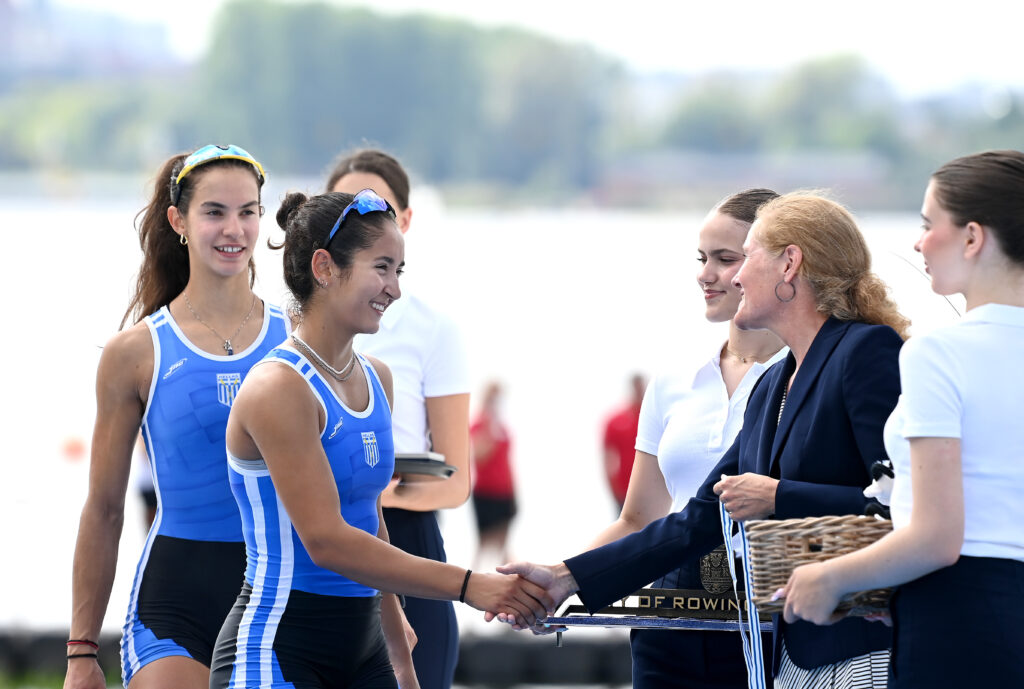
The Greeks in particular seem to be churning out young stars, led by Dimitra Kontou. Stepping up to openweight after winning two consecutive world under 23 gold medals in the lightweight women’s double sculls (oh, and an Olympic bronze medal), Kontou added openweight double sculls gold in Poznan. She has two more years left as an under 23 so could feasibly match Wiesenthal with six medals before she finishes.
Greece brought several other teenagers to Poznan who go home with medals around their necks. Junior world champions Varvara Lykomitrou and Gavriela Lioliou both added under 23 gold medals, and 16-year-old Paschalina Mouratidou made an impressive world debut with Lioliou in the lightweight women’s double sculls. Eleni Diavati picked up silver in the women’s single sculls.
Türkiye’s single sculls champions, Cevdet Ege Mutlu and Halil Kaan Koroglu, have both been making an impression on the senior stage this year and they also impressed in Poznan.
With the PR3 single sculls also making their debut in Poznan, Australia’s two representatives, Sam Stunell and Isobel Egan, also made it clear they want to make a splash in the para-rowing world. Although Egan could not overturn Ukraine’s Dariia Kotyk, she pushed her older rival all the way and at only 17 she has plenty of time to win her own under 23 title.
And the ones watching on
Finally, it was interesting to note that a whole bunch of this year’s under 23 rowers are a generation whose parents, aunts or uncles all competed at the Sydney 2000 Olympic Games, exactly 25 years ago. Three of them have relatives who were medallists at those games.
New Zealander Matthew Waddell, silver medallist in the men’s eight, says he was inspired growing up by his uncle Rob – the men’s single sculls champion in Sydney, and double world champion.
Ruby Cop, who won the women’s single sculls B-final in Poznan, is the daughter of Slovenian legend Iztok, a four-time Olympic medallist (including gold in the double in Sydney) and four-time world champion.
And Rhiannon Luke, who was eighth overall in the women’s pair, is the daughter of Miriam Luke and the niece of Guin Batten; the Batten sisters made history when they became the first British women to win an Olympic rowing medal when they grabbed silver in the quad 25 years ago.
Now the next generation are forging their own paths – inspired by their parents, but making their own impressions on the rowing world. We can’t wait to watch them develop in the years to come.