


30 Sep 2025
September 2025: Kathrin Marchand
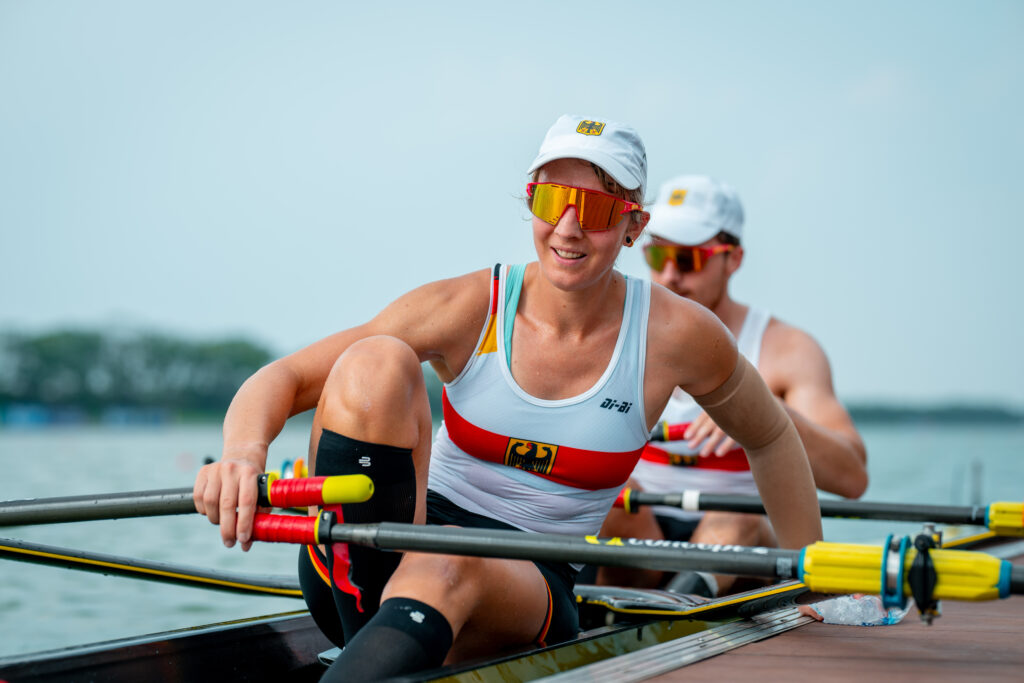
ROWER OF THE MONTH – She is an Olympian and Paralympian, a European champion, and at the 2025 World Rowing Championships won medals in both PR3 events, winning gold in the double sculls with Valentin Luz and bronze in the mixed coxed four. Germany’s Kathrin Marchand is the September Rower of the Month.
How did you get into rowing?
I started rowing in 2005 because my whole family rows, and my brother told me I had a good physique – long legs, I’m a tall girl. So I started rowing.
I thought rowing was a really boring sport, because you’re doing one movement the whole time for 90 minutes or 250 times in a race. I actually wanted to quit rowing because it was so boring, I came from ball sports and played field hockey before. But I didn’t quit, and I’m still here – again.
What was the highlight of the first stage of your career, until your first retirement in 2016?
The Olympic Games in 2012, because I was only 21 years old. I had no idea what to expect. I didn’t expect to go, so this was a real highlight. And of course the 2016 Olympic Games, because in the years before I was in the fastest pair in Germany. It was amazing to be there as the eighth fastest boat in the whole world.
Also the European Championships in 2016, where was had one 150m section next to the British pair and the commentator was exhausted because we were about to catch them – we didn’t, at all – but we had 10 strokes that were the best 10 strokes of my life.
What got you back into rowing after your stroke in 2021?
I had a lot of time after my stroke, I wasn’t able to work yet. I heard a report about the Paralympic Winter Games and I thought maybe I could go back to rowing to compete at the Paralympic summer Games. I was just thinking about the good times we had in Rio and London, and being in this rowing family, so I thought about starting again and seeing what happened.
How was the Paris Paralympic experience and the close fourth place (in a photofinish with France)?
We did a really good job, and we had a really good four. I think the French team was just that bit better on that day.
The Games were amazing, the whole crowd was shouting for us and supported us, even better than in Rio. So the Games were really good but the result was disappointing.
You’re also attempting to qualify for the Milano Cortina 2026 Winter Paralympic Games; what is your motivation for taking up another sport?
It’s because of the Paris Paralympic Games. I just wanted to be part of the Paralympic Games in Paris, but the result was so disappointing I felt like I should stop my rowing career again. At that point someone came to me and asked if I wanted to do para-ski cross country, and I just felt like I want to give it a try and see what happens.
I’m surprised that I’m doing a good job. The thing is that you can’t do skiing in the summer, so I have a lot of time because I reduced my job (as a doctor) because of sport. So I thought I might go to the European Championships in rowing to stay fit, and then we just did a good job, so I thought we have to go to the World Championships as well. So I’m just here because I’m surprised by our results at the Europeans. I didn’t plan to be here.
Did the Paralympic Games feel different from the Olympic Games you raced at?
I feel like the Paralympic family is more familiar. It’s smaller.
The best example is that a competitor came to me before the final in Paris and wished me good luck. They did not expect to get a medal, but he knew that we were in line for getting a bronze medal maybe. No competitor at the Olympics would wish you good luck before a race. I know all my competitors, or most of them, and I talk to them. It’s like a small family.
You’ve taken up sculling for this season – how has that adjustment been?
It’s been really tough. I did almost 20 years of sweep rowing and now I’m sculling. The beginning was really tough, I still feel uncomfortable in a sculling boat because the sculls are so thin, like toothpicks. I’m getting into it but I still feel like I’m leaning to the right when I’m at the front.
There’s an extra challenge because my left side really gets weak after a few metres, and I really have to hold on to the blade. When I do sweep rowing I have two hands for one blade, now I have one, and I’m always afraid of losing the blade. I feel like my left side is slower than my right side, and the coordination with the right and left side is something I’m still working on. It’s a challenge for me: I could go the easy way and say ‘I want to be back in the four’, but I don’t feel the German four is able to do as well in the world championships because of the British four, so I wanted to give it a try and see how far I can go in the double.
What was the domestic selection battle like against Paralympic bronze medallists Jan Helmich and Hermine Krumbein?
We didn’t win the German championships. It was really windy and I’d just come from my winter season on skis. Two weeks later we had the German championships and we lost by three seconds. Later in the season we did a domestic race in Germany and we beat them by eight seconds, because we’d been more in practice.
It’s amazing to see that we have two doubles in Germany that could take gold and silver at the world championships, but there’s only one spot for Germany. The domestic challenge makes us even faster, because we know that it’s maybe even harder to get into the national team than get a medal at the worlds.
When did the plan to double up in the PR3 coxed four and mixed double sculls originate, and what has that been like?
It’s not my intention to be in two boats forever, but we don’t have enough para rowers in Germany, so without me the four could not start. I just do it for the team because we need the money from the federation: if we don’t have a four, we don’t get money. Para-rowing in Germany should continue.
Where’s your favourite place to row?
Bled in Slovenia, it’s really beautiful – and Lucerne of course. And Cologne, my home town.
What’s on the erg playlist?
Nineties. I feel like I’m getting old. I’m the third oldest on the German team, and I just like 90s because I was born in the 90s.
Who has inspired you?
In rowing, it’s my pairs partner Kerstin Hartmann. Even when we were five seconds ahead of the field she was saying ‘we want more, we want more’. She was so into it, she taught me how to train and how to race. This is what I’ve tried to teach others when rowing with younger guys.
What’s the best piece of advice anyone’s ever given you?
It’s to focus when it’s necessary to stay focused, but stay relaxed when it’s time to relax. Don’t try to be always on 100 per cent. There’s a time when you need 110 per cent but also times when you can go down to 50 and drink a beer, and it’s no problem.
Maybe if your time is not now, it can be later: a career can be decades long, so don’t worry.