

30 Sep 2025
Tiger stripes in Shanghai: the development of Malaysian rowing
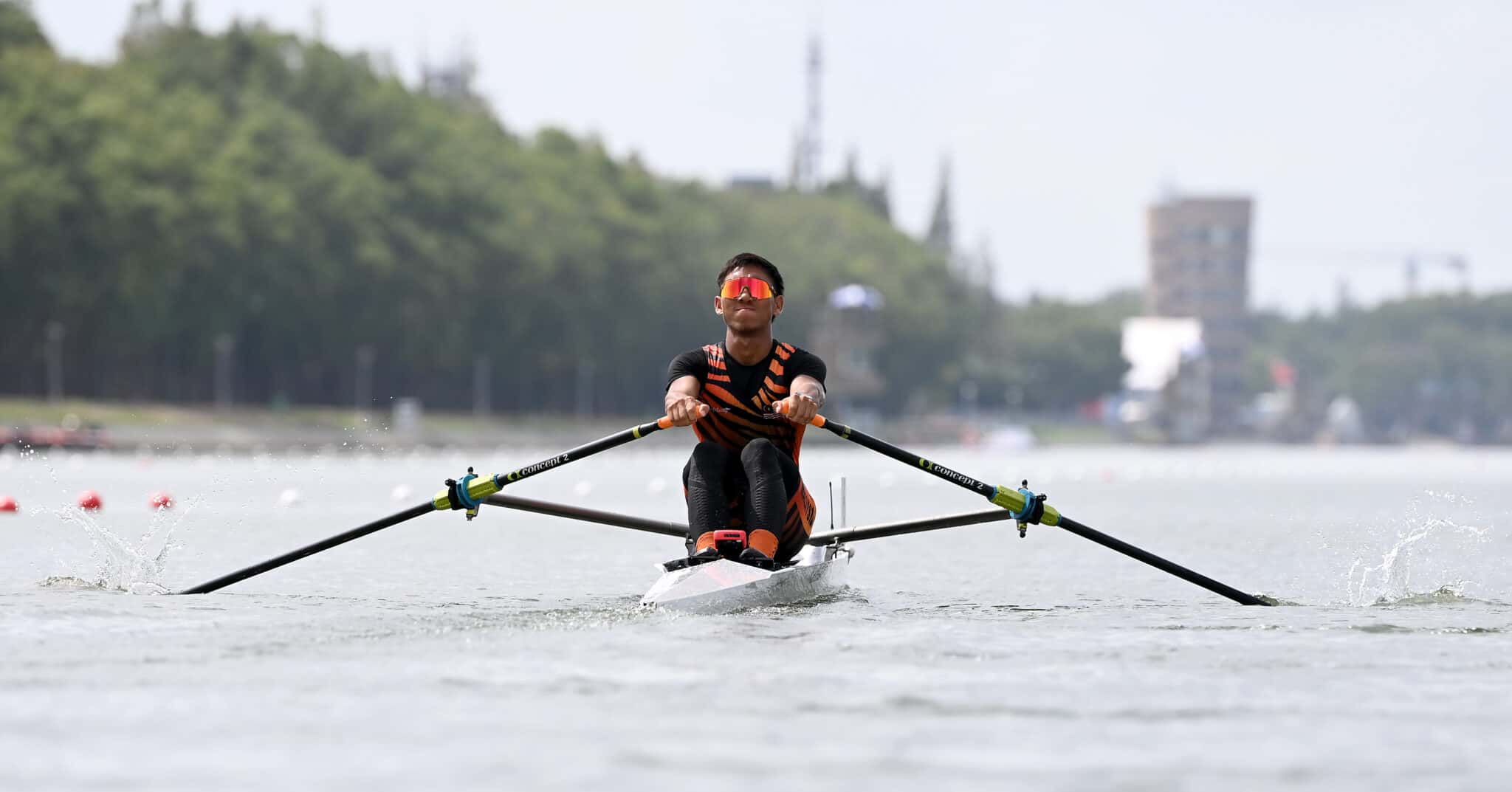
If you have been watching the 2025 World Rowing Championships you may well have spotted the eye-catching tiger stripes of the Malaysian team on the start line – especially because at world level, Malaysia are not regular competitors.
The Shanghai regatta marks only the third time the south-east Asian nation has sent a team to the World Rowing Championships. Malaysia previously competed in 2005 in Gifu, Japan; and in 2013 in Chungju, Republic of Korea. Their 2013 team was the biggest yet, with seven competitors.
This year, Malaysia sent five athletes to Shanghai to race in the men’s single sculls, lightweight women’s and men’s single sculls, and men’s pair. Unfortunately lightweight women’s single sculler Zakaria Nurzarinah had to withdraw for medical reasons, but the men all competed. All five athletes are supported by the World Rowing Development Programme.
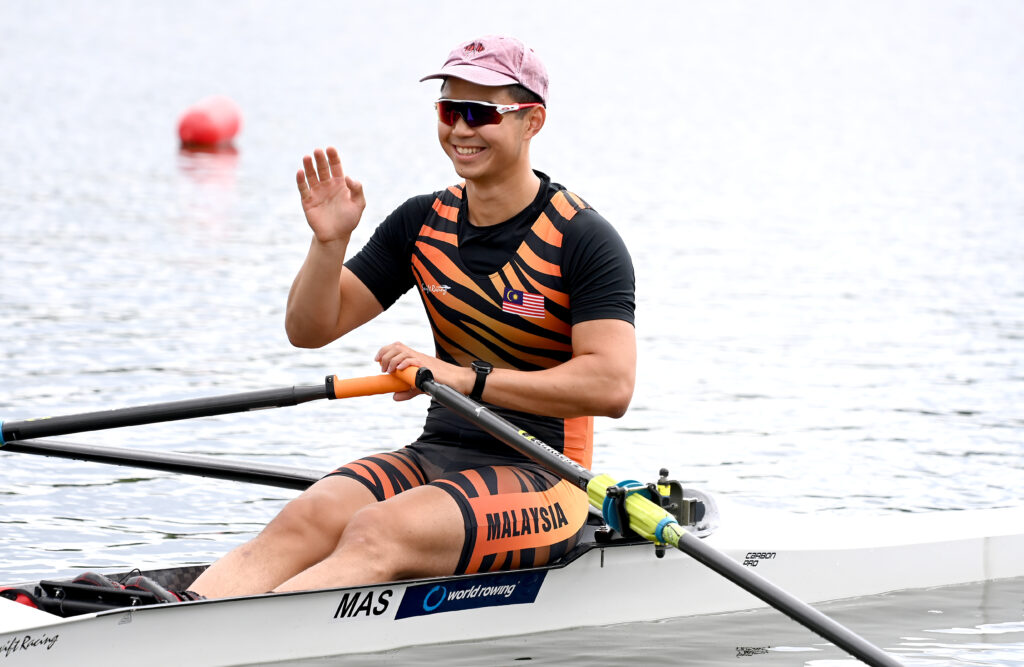
Men’s single sculler Ong Kheng Aik – known as James – is the only member of the team not drawn from the main pipeline of Malaysian rowers, UTHM (Universiti Tun Hussein Onn Malaysia). UTHM’s rowing club, the Barracudas, began life in 2008 with one ergo. Three of the national team competing in Shanghai are current students, while Mohd Arif Ashraf, one half of the men’s pair, is an alumnus.
Ong learned to row at King’s College London two and a half years ago after seeing a “bunch of blokes who seemed quite nice and friendly” at Freshers’ Fair, having moved to the UK to begin a law degree. He grew up in Malaysia, but says school rowing is limited back home.
A novice year at King’s was followed by a season at University of London Boat Club, where Ong improved and decided to reach out to the Malaysian Rowing Association to see if he could represent his country. They were keen, and after a crash course in learning to scull, he competed at the 2024 Southeast Asian Under 23 Championships.
Earlier this year, Ong became the first Malaysian rower to ever race at the World Rowing Under 23 Championships, finishing third in the E-final.
“It was quite surreal, honestly, to be able to represent my country at such a high level. The results leave something to be desired, there’s still room to grow, honestly, but just to have the opportunity is a great starting point,” he says.
He explains that in Malaysia each of the country’s 13 states has its own rowing association, with the best athletes being picked up by the national federation. The three main places to row are the lake where UTHM train; about 11km of open water in the administrative capital of Putrajaya, “although there is quite interesting boat traffic that goes there”, Ong adds; and a stretch of canal at the Selangor Rowing Training Center, in a small village.
“It’s kind of scruffy, but it’s amazing water because it’s always flat, there’s no wind, so you can go up and down for 4ks very easily, and there’s no traffic,” says Ong.
He says there is a decent fleet of boats, adding: “We make do with what we have, we’re quite economical with our resources. We do have very dedicated coaches, even though they’re not necessarily employed full time.
“The president of our national body still comes down every weekend on Saturdays and Sundays to watch us train. He actually drove me back and forth to training this whole time when I was back in Malaysia,” Ong says.
Rowing is a small but growing sport in Malaysia. The universities and indoor rowing provide a pipeline, despite the constraints of limited flat water and the hot, humid climate.
But there is optimism for the future of the sport. Malaysia has not yet had a rower at a summer Olympic Games. Ashraf and Nurzarinah both raced at the 2024 Asian and Oceania Olympic Qualification Regatta, but were some way off the pace.
“At this point we’re cultivating talent. We’re trying to see what we have. We’re honing our skills, building our physiology, and we’ll see how it goes in the 2028 trials. But we’re hopeful, that’s for sure,” says Ong.
Beach sprints is a potential avenue for growth. Malaysian rowers raced at the recent Asian Rowing Beach Sprint Championships, with junior crews competing at the 2025 Asian Rowing Beach Sprint Finals, and Malaysia hosted its own beach sprint competition in Penang earlier this year.
“We do have a lot of coastline and we don’t have that much usable canal space. It is a lot more accessible for a lot more people. It’s good to spread the sport that way,” Ong acknowledges.
On the classic rowing front, Malaysia’s participation in Shanghai is an opportunity to learn from the best in the world.
“We just have a very passionate team and a very dedicated team. This was seen more as a learning opportunity just to see how we stack up against the rest of the world. There are a lot of lessons to be learned here, and I hope we learn them,” says Ong.
“There’s something to be said just from watching how the big great powers of rowing operate. It’s really quite different. There’s a lot more resources, but it’s used very effectively.”
He says his own experience of Shanghai, lining up in the same heat as Olympic silver medallist Yauheni Zalaty, and training next to the likes of the Sinkovic brothers, has been “surreal”, but also “extremely, extremely exciting”.
And although Ong is heading back to the UK to complete his law degree, he is very much looking forward to seeing what the future holds for his own career and Malaysian rowing.