

18 Feb 2026
February 2026 : Andrea Panizza
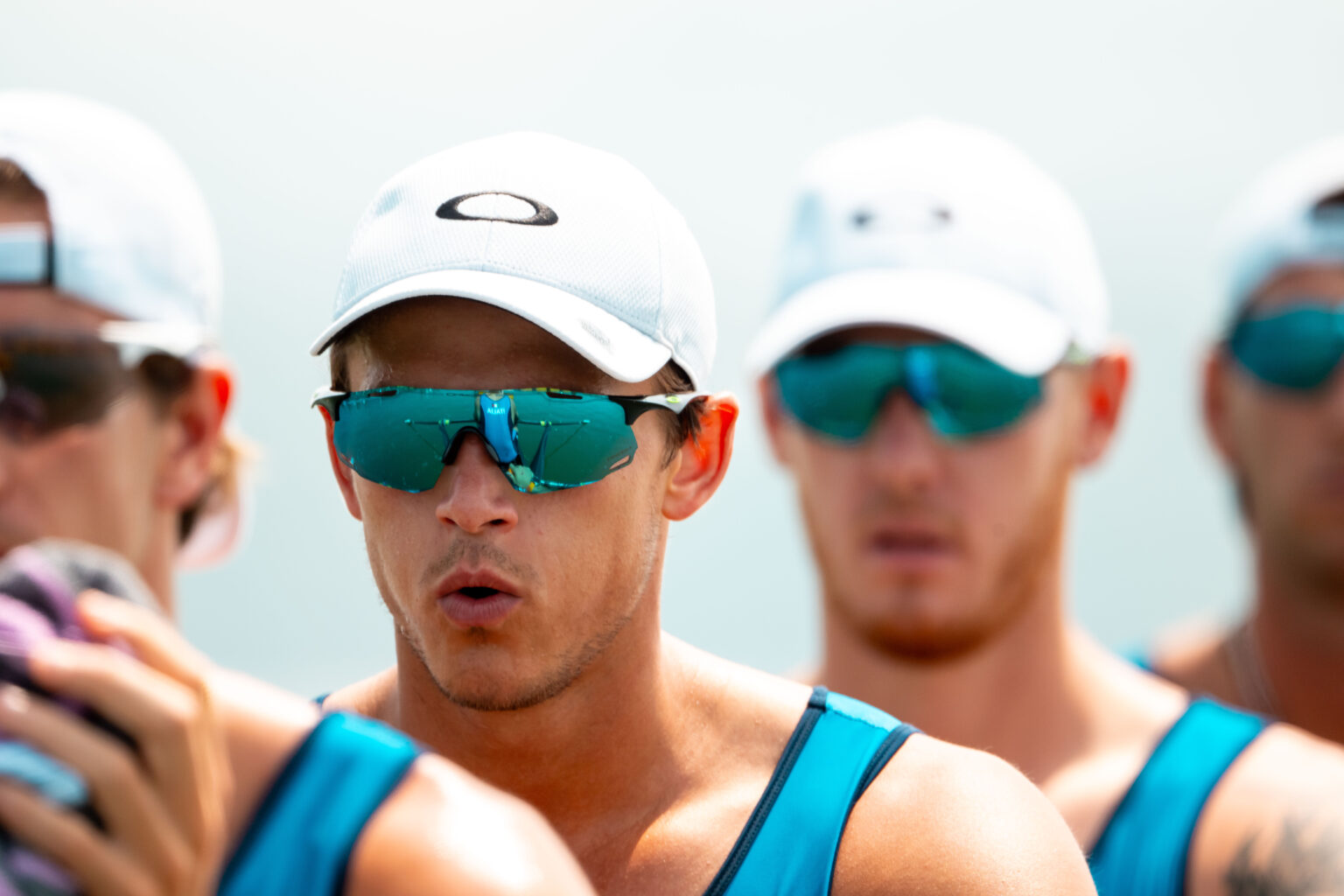
Two-time Olympian, Olympic silver medallist and three-time World Champion, already the success for 27-year-old Andrea Panizza is measurable and extensive. The Italian rower also recently was named as part of the World Rowing Men’s Crew of the Year, and will be competing in the upcoming 2026 World Rowing Virtual Indoor Championships, presented by Concept2. He is the February 2026 Rower of the Month.
Where are you at present and what does your daily routine look like?
I’m in Piediluco at a training camp with the national team. My daily routine is quite structured: in the morning we usually have an on‑water rowing session of around 24 km, and in the afternoon I ride the bike every day. Strength training alternates between classic weightlifting sessions and weight‑based circuits.
Tell us how you first discovered rowing.
Rowing has always been part of my family. My two sisters, my brother, and my mother rowed, so it felt natural for me to start as well. I’m from Mandello del Lario, where rowing is the historic sport of the town thanks to Canottieri Moto Guzzi. You could say rowing was always in the air.
What made you decide to pursue rowing at the elite level?
I genuinely enjoy rowing. It’s a sport that constantly challenges you and helps you grow, not only physically but also as a person. I love pushing myself, overcoming difficulties, and competing. Doing this together with my teammates makes the hard moments easier and the good moments even more special. Over time, that daily commitment turned into a real desire to see how far I could go at the highest level.
You’ve been on the Italian national team since a junior in 2015, have you taken any breaks?
The first was in 2020, after surgery on my right shoulder. The second was in 2022, when I had to stop for about five months due to heart complications following Covid.
What attracted you to try for the Italian bobsleigh team?
After the disappointment of Tokyo (Andrea’s quad finished fifth), I wanted to try something new, mainly for fun. I immediately liked the environment; the group was very welcoming, and the speed and adrenaline of the descent really excited me.
That said, I promised myself that until Paris I would focus fully on rowing, with the idea of possibly trying again later for the home Olympics.
Do you see yourself doing bobsleigh in the future?
Honestly, I don’t know. It’s quite difficult to combine the two sports. Bobsleigh requires a purely explosive approach, and I would need to dedicate myself fully to it — even stopping rowing sessions — because they didn’t allow me to train running and power at the highest quality. We’ll see!
You’re competing in the World Rowing Virtual Indoor Championships this month, how do you prepare for indoor rowing competitions?
Yes, I’m competing! I signed up for the 1‑minute and 1000 m races because I’ve wanted to try indoor competitions for years. This year there’s no 2000 m, but these distances will still be fun.
I’ve never truly prepared seriously for an indoor race before. I usually add a few specific sessions depending on the test or competition, trying distances like 1500 m or 1000 m, and some intervals to understand race pace. This time, whenever possible between training sessions, I’m adding more explosive work for the 1‑minute race, which is probably the one I’ll focus on the most.
Do you love or hate training on the erg?
I like training on the erg. Sometimes I hate it when I’m tired, but there’s no tool more honest than the ergometer. Without external factors, it really shows your true physiological value.
What is your favourite rowing workout?
Probably race‑pace pieces, whatever the distance — 500, 1000, or 1500 meters. I love rowing at race speed. The long, slow winter base work… not so much 😂
Tell us the difference for you between the Tokyo and Paris Olympics?
I don’t think there was a huge difference in terms of preparation. In Tokyo we arrived in great shape and throughout the year we had shown we could be a fast crew. Unfortunately, during the final we made a mistake that cost us dearly.
In Paris, we also knew we were very fast — maybe even faster than in Tokyo — but there was some fear of making the same mistake again. Perhaps that fear prevented us from expressing our full potential. The silver medal was incredibly special for all of us. We carried the weight of Tokyo for years and we really wanted that medal, especially because of the promise we made to the parents of Filippo Mondelli.
What would you be doing if you weren’t rowing?
I would probably be working as a builder with my father. I live in a small mountain town where there’s always work to be done, and I think I would have followed his path.
Do you have a favourite podcast or book?
More than podcasts, I read a lot. I’m very interested in topics related to sport, and in the future I’d like to become a coach. So I read books about nutrition, training programming, and the physiological aspects of performance.
If you could invite anyone to dinner who would it be?
Filippo Mondelli, because he left us too soon and I would love to see him again. Giuseppe Moioli, my coach, who passed away last year. Talking with him after training camps was always a pleasure, and if he had seen the world title we won, I know he would have been happy. With him, dinner was always a celebration. My parents, because I don’t get to spend enough time with them while I’m away at training camps, and I’d love to slow down and really enjoy time together.
Tell us your favourite quote from a fellow rower or coach.
“Simple things done in an extraordinary way.”
“A horse doesn’t turn into a donkey.”
– Vittorio Altobelli, my coach