

08 Mar 2026
50 years of women’s rowing at the Olympic Games
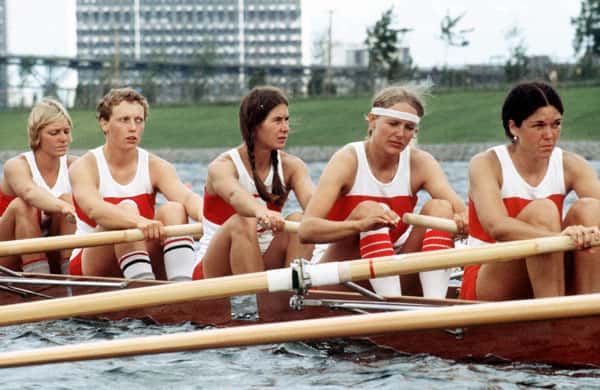
In summer 1976, almost 50 years ago, a major milestone in rowing’s path towards gender equality was reached: the inclusion of women’s rowing at the Olympic Games.
Although rowing is one of the original sports in the modern Olympic Games, it took 80 years from the first ‘modern’ Olympics in 1896 for women to be included in the programme. But at the Montréal 1976 Olympic Games, 205 women lined up in six events to contest the first-ever Olympic medals for female rowers.
The women – competing in single and double sculls, coxless pairs, coxed fours and coxed quadruple sculls, and eights – would only race over 1,000m in Montréal. It took another three Olympiads for the racing distance to be extended to 2,000m to match the men’s racing, and gender parity would not be reached until the Tokyo 2020 Olympic Games (in 2021), when men and women finally raced the same seven events.
“The 1976 Olympic Games for me was not only a game, it was a life experience,” says Guylaine Bernier, who raced for Canada in the coxed quadruple sculls, finishing eighth.
“Being selected to go to the Olympics, and the journey to get there, was something very special,” Bernier says.
She admits initially she was sorry not to be travelling to another country or city for the Olympics, but has come to appreciate having had a home Olympic experience.
“I go often to the Olympic stadium and every time I go there I see my name on the big board with the names of all the Canadian Olympic participants,” she says. “Every time I go there I’m proud. During the Olympics the city was crazy, there was so many things to do, the crowd was everywhere.”
For women’s rowing, the impact of the 1976 Olympic Games has been huge, but Bernier says at the time she and her teammates did not realise the significance. It was only later they became aware they had written themselves into history.
“The impact of the first time having women rowing in the programme of the Olympic Games changed the development of rowing, not only in Québec, in Canada, everywhere in the world. It opened the door. It was like a spark,” she adds.
Canada had very little women’s rowing before Montréal, but as a result of being awarded the 1976 Games, there was a concerted effort – especially in Québec – to build a team. Bernier, who had been heavily into all types of water sports including swimming, water polo and scuba diving, got involved after one of her diving students suggested she come down to the boathouse and try rowing. She was instantly hooked and, less than five years later, was an Olympian.
And although women were racing half the distance of the men, Bernier says that did not matter.
“We didn’t feel diminished because we didn’t have the same distance, we felt welcome because we had something for us,” she points out.
East Germany dominated the medal table in 1976, winning a medal in every event including four golds; Bulgaria claimed the other two gold medals in the double sculls and coxless pair. Although Bernier and her Canadian teammates came away empty-handed, she says they did not go in with medal expectations – unlike those who followed them, with a recent highlight being gold in the women’s eight at the Tokyo 2020 Olympic Games.
“With the improvement in financial support athletes now can do more than one Olympic Games. We’re so proud of our athletes, men and women, but proudest of the women,” says Bernier.
The legacy of 1976 was huge in many ways. Many of the women who competed in Montréal that summer 50 years ago went on to hold senior positions in rowing both domestically and internationally.
For example, the USA’s Anita DeFrantz served two terms as World Rowing vice-president and, in 2013, was succeeded by Canada’s Tricia Smith – both of them 1976 Olympians. DeFrantz was also the first-ever female vice-president of the International Olympic Committee, while Smith is the current president of the Canadian Olympic Committee.
Bernier focused on her full-time job after 1976, but in tandem started to give back to rowing by getting heavily involved in coaching, umpiring and regatta organisation, including the 2001 World Masters Regatta. She was the first woman and the first Canadian to serve on the FISA Umpires’ Commission.
Now, in the golden jubilee year for women’s rowing at the Olympics, Bernier is part of the organising committee for a celebratory event in Montréal to commemorate the 1976 Olympic Games and women’s rowing. To be held from Thursday 30 July to Saturday 1 August, the event will feature mixed relay racing over 250m – ‘beach sprint style’ – in coastal boats, but on the Olympic Basin in Montréal. Bernier is keen to welcome any Olympians and masters rowers for the celebration to have fun and celebrate the legacy of the 1976 Games.
For more information, click here.