


09 Aug 2026
The Doctor Is In: US Olympian Gevvie Stone's New Race
In Plovdiv, on her first international trip as US Rowing’s team doctor, Gevvie Stone found something she wasn’t expecting — the same butterflies she used to feel on the start line, just from a different seat.
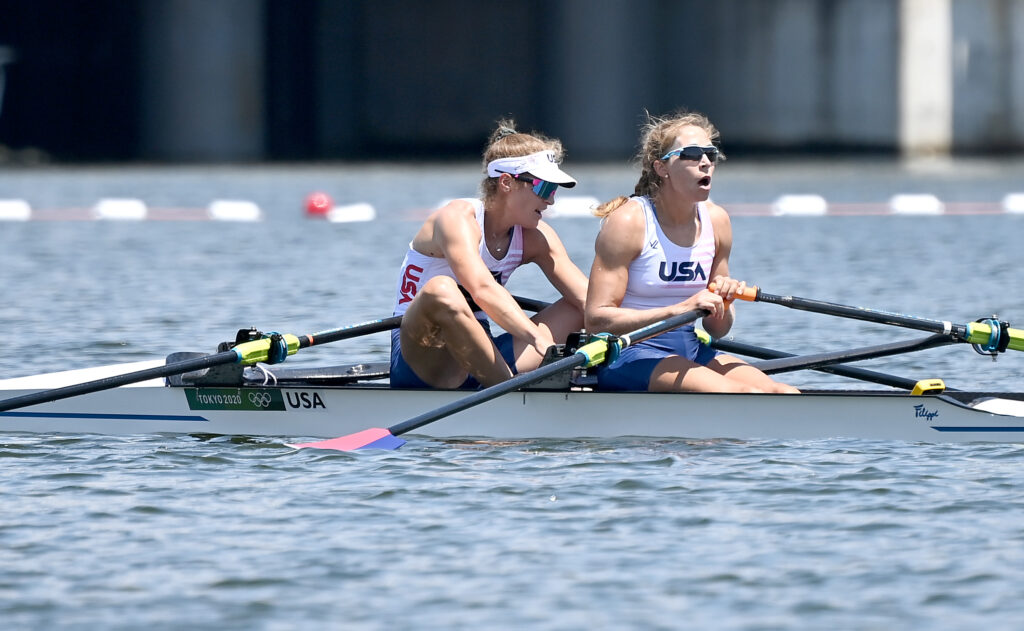
Five years ago, Gevvie Stone raced her last stroke at an Olympic Games. This week, she’s back on a regatta course for the first time since — not as an athlete, but as the doctor in the medical tent, patching up the next generation of American rowers at the 2026 World Rowing Under 19 Championships.
She wasn’t prepared for what it would feel like.
“I wasn’t prepared for how excited I would get coming back to a course,” Stone says. “As an athlete, you get a thrill every time you come to a regatta because of the anticipation of racing and being at the venue. Even when it’s a course you’ve been to many times, there’s always that excitement.”
I wasn’t prepared for how excited I would get coming back to a course.” – Gevvie
It’s a course she’s never actually raced — this is her first time in Plovdiv — but the feeling was instantly familiar. “I’ve been away from rowing at the elite level for five years, and I certainly wasn’t prepared for the jitters and butterflies I felt when we got back to the course. Even though I’m not racing, just being around that environment, being excited about what the team is going to do and what the competition is going to bring — it’s really special.”
Two Careers, One Grind
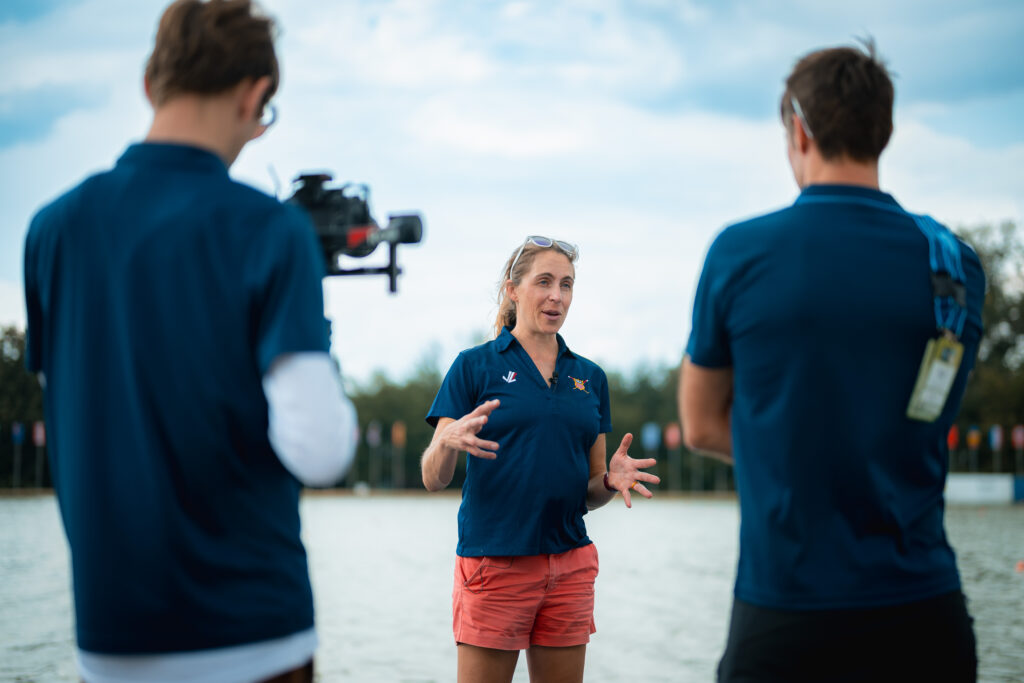
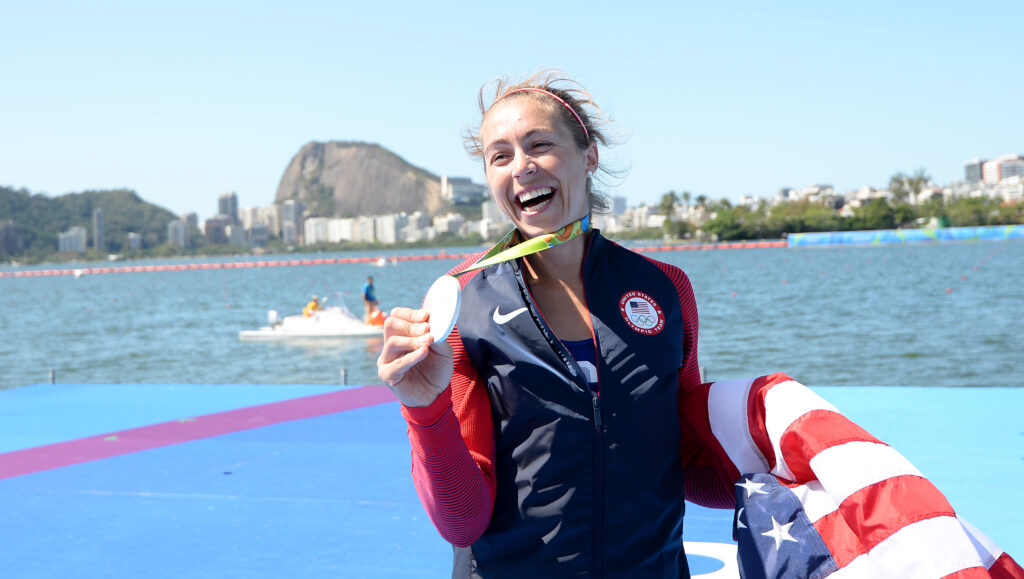
Stone’s path back to elite sport runs through medicine, not around it. A three-time Olympian — London 2012, Rio 2016, where she won silver in the single sculls, and Tokyo 2020 — she is also a graduate of Princeton and Tufts medical school, and now practices emergency and sports medicine at Cambridge Health Alliance. For most of her rowing career, she trained full-time for global finals and studied for medical exams in the same breath.
Ask her what one discipline taught her about the other, and she doesn’t hesitate.
“They’re both hard, and they both require an ability to suffer and grind through, to set goals and then, when you achieve those goals, realise that all of it was worth it,” she says. “Rowing is a lot about training in the dark — so much of your training is in the dark and then people only see that tiny little bit of it when you race. Medicine is similar. There’s a lot of grinding through.”
“I love the challenge,” she adds. “Whether it was studying anatomy and drawing out the body again and again, or practicing legs-only rowing again and again, doing the same pieces over and over — I’ve found a huge source of gratification in seeing what I’m capable of.”
It’s a mindset she’s happy to name. “You could call me a Type Two Fun junkie,” she laughs.
“You could call me a Type Two Fun junkie.” – Gevvie Stone
That grind now takes a different shape. Before Plovdiv, Stone spent part of the year working with the US Biathlon team’s development group, brought on by the programme’s head doctor after she’d gained experience with the sport during her medical fellowship. The learning curve, she says, was steeper than she expected — until it wasn’t.
“At one of my first World Cups, the coaches asked me to go out and help with ski testing. I said, ‘I do this recreationally, guys, you don’t want me doing this.’ And they said, ‘It’s just like boats.’ And it’s true — it’s really about feeling that glide and seeing what you can do without effort. Watching a boat run versus watching skis glide is very similar in terms of assessing speed.”
Born Into It & “The Best Team I Never Made”
Rowing was never really a choice for Stone so much as an inheritance. Her mother was an Olympian and World Championships silver medallist; her father would have gone to the 1980 Olympics before the US boycott. But her parents, both of whom coached her at different points, never pushed the sport on her.
“The first things I learned about rowing weren’t actually about the sport itself, but about the teamwork involved,” she says, remembering the reunions at her father’s old college boathouse around the Head of the Charles each year. “I don’t even know if I watched the rowing. I remember playing on the slings, playing in the tanks and eating a lot of snacks. But I definitely absorbed how much the sport meant to all of them. I got a sense that a team is about what the people mean to each other.”
She played soccer, lacrosse and swam growing up — and it was a lacrosse tryout, not a rowing epiphany, that finally put her in a boat. “I was really bad at soccer. I told myself if I made varsity lacrosse my sophomore year, I would keep playing lacrosse. I didn’t make the team, so I started rowing my junior year. And the rest is history.” Within that first year, her four won Youth Nationals.
“The best team I never made,” she says, of the lacrosse squad that indirectly launched an Olympic career.
What She Hopes to Give Her Own Son
Stone is now a mother herself to a son she calls Bertie, and the experience has sharpened her view of the parents who line every regatta course — including this one in Plovdiv.
“My parents did so much to enable me to row, especially through the elite years when you’re not working. At every level, parents do the things you can quantify — financially, with their time, snacks and all the rest. But the more important thing is being that good foundation,” she says. “I’ve seen some parents on this trip do it just right — say exactly the thing their kid needs to hear after a race that either went well, or in our case today, didn’t go as well as the athletes wanted.”
“I’ve seen some parents on this trip do it just right — say exactly the thing their kid needs to hear after a race.” – Gevvie
Her hope for Bertie is the same freedom her own parents gave her. “Like my parents, I hope never to force him into anything he doesn’t want to do. I hope he finds a sport that he loves — it doesn’t have to be rowing. It might be, but it doesn’t have to be. I think you learn so much about yourself through being on a team, pushing yourself physically and mentally, and making the commitment required.”
Even the single scull, she points out — the boat that defined her own elite career — was never really a solitary pursuit. “I trained with a group of masters rowers in Boston. They weren’t my age, and they weren’t women, but they were my speed, and I was able to achieve what I did because they were beside me, pushing me. Even if you’re doing something individually, you’re capable of achieving what you achieve because of the people who surround you.”
Beyond LA28
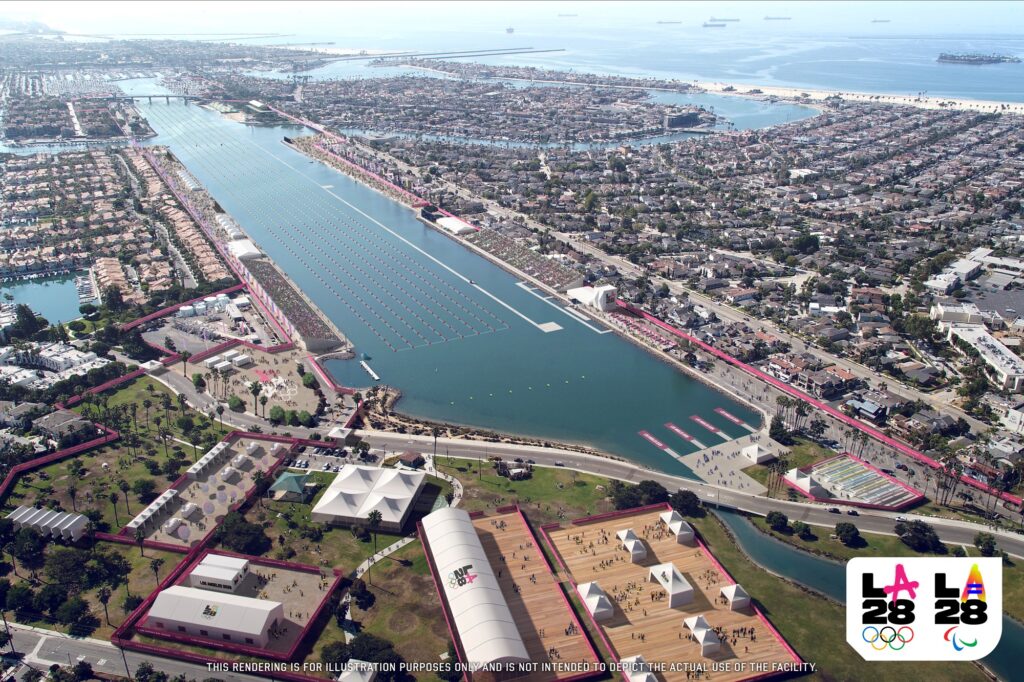
With the Olympics returning to American soil for the first time since Stone’s own childhood, she’s had a preview of what home advantage might feel like — not from LA, but from Sarasota, host of the 2017 World Rowing Championships.
“I went into that completely underprepared for how much it means to have a home course,” she says. “I think the Olympics will magnify that so much. It’s not just the home rowing community, it’s the home sporting community — sports fans across the whole country.” She points to this summer’s World Cup on US soil as an early sign of what’s coming. “It was special to have something about the country hosting a sporting event that made us feel proud to be Americans. I think the Olympics will do that again, on a broader level, because it’s more than one sport. For rowing, as a small sport, the exposure is huge.”
“For rowing, as a small sport, the (Olympic) exposure is huge.” – Gevvie
Long Beach will bring something else new to LA28: Beach Sprints, on the Olympic programme for the first time. Stone, who has raced them herself, is a convert.
“Rowing is hard, and Beach Sprints is Type Two Fun — almost Type One Fun,” she says. “At Boston Beach Sprints, all the finalists on the podium were wearing foam fish or whale hats. The referees wear Hawaiian shirts. It’s fast-paced, a little more chaotic — there’s still plenty of pressure, it’s still high-level sport, but it’s certainly more fun.”
She sees it as more than entertainment — a genuine growth opportunity for the sport worldwide, especially with the loss of lightweight boat classes that once offered smaller nations a path into competition. “Having Beach Sprints, which includes individual-person boats, could help us see more countries and more worldwide involvement in the sport,” she says. “A lot of countries have some coastline. The boats are more stable, hardier — they can endure the trials and tribulations of a novice rower. For worldwide appeal, it’s really important to have forms of the sport that are accessible, not only in the US, but worldwide.”
Telling Rowing’s Story
It’s a subject Stone has clearly thought about — what it will take for the sport to reach beyond its existing fanbase. Asked where rowing could do a better job telling its own stories, she doesn’t hold back.
“I think it’s definitely getting better, particularly with the social media presence and making the athletes into people,” she says. “The more you can make the athletes’ names recognisable, the better — ask them questions that make them human. Rowing isn’t necessarily a personality-driven sport right now. I think we’re missing some of those personalities who can draw people in.”
“The more you can make the athletes’ names recognisable, the better.” – Gevvie on where she sees promoting rowing needing to further evolve
She points back a decade, to a generation of rowers whose names transcended the sport — Olaf Tufte, Mahé Drysdale, Ondřej Synek and others on the men’s side; Kim Crow, Frida Svensson and others on the women’s — as proof of what’s possible when the right characters get the spotlight. “They had such a big impact that it trickled down. Find those people. They don’t all have to come from the single.”
Full Circle
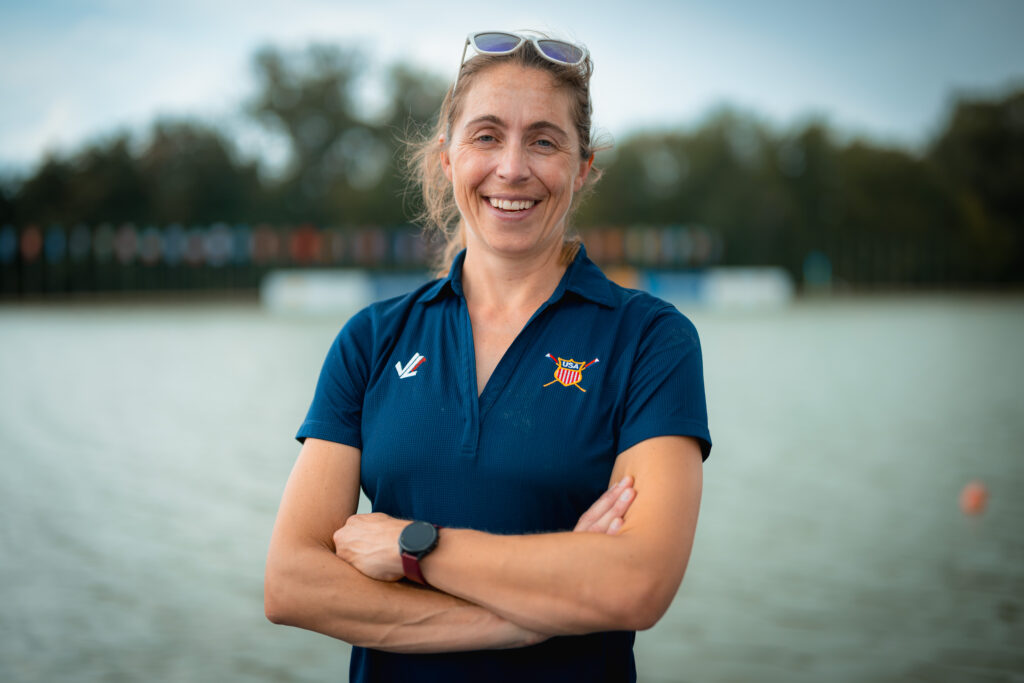
Three Olympic Games, a medical degree, an emergency room, a return trip to the same regattas that once defined her — Stone’s rowing story keeps finding new chapters to write. Asked what the sport has given her, across a life spent almost entirely inside it, she pauses before answering.
“Rowing has given me a lot more than I can answer in one question,” she says. “But if I had to put it in a couple of words — it made me more of a team player, for sure. Learning when to listen, when to speak up, what to do for the greater good rather than for your own sake — that makes you a stronger person. And the ability to gradually get better, to know that when I put hard work in, I could achieve my goals — that’s ingrained a confidence in me that’s helped make me who I am. Those two things are huge in terms of who I am as a former athlete, a doctor, and a mom.”
“To know that when I put hard work in, I could achieve my goals.” – Gevvie on what rowing’s given her in other aspects of life
For now, that confidence is being put to use in a medical tent in Plovdiv, watching a new generation of American rowers chase the same feeling she once did — and finding, to her own surprise, that some of that old thrill never really left.
Gevvie Stone served as team doctor for US Rowing at the 2026 World Rowing Under 19 Championships in Plovdiv, Bulgaria — her first international trip in the role.