


14 Oct 2026
Beach sprints’ rapid route from Shenzhen to Los Angeles
It is now seven years since the pioneers of beach sprints gathered in China for the world championship debut for what was then a rowing discipline in its infancy. A total of 35 crews from 13 nations took part in the 2019 World Rowing Beach Sprint Finals in Shenzhen, racing in four events.

Shenzhen was the first World Championships for a sport that had developed over the preceding four years, with its formal international debut at the 2015 Mediterranean Games and a test of the format we recognize today at the end of the 2015 World Rowing Coastal Championships in Lima.
Now, China is hosting its second World Rowing Beach Sprint Finals. This year, 222 crews from 53 nations will race in Qingdao, across 10 events for both juniors and seniors, including an inclusion event. It is the second-largest entry ever for a World Rowing Beach Sprint Finals, the largest entry to gather outside Europe, and demonstrates how the discipline has exploded in a very short space of time.
And of course, in less than two years, coastal rowing beach sprints will make their Olympic debut in Los Angeles – with juniors paving the way, racing at the Dakar 2026 Youth Olympic Games in two weeks’ time.
“It’s really well established now, and not just in each of the continents but in each of the national championships,” says Guin Batten, World Rowing Coastal Commission chair, and one of the discipline’s originators.
“If I look at my phone at any weekend over the summer period, you’ve got at least three events happening around the world where people are sharing their crazy photographs and the crazy stories of what’s going on.”
Bringing Fresh Beach Vibes to Rowing
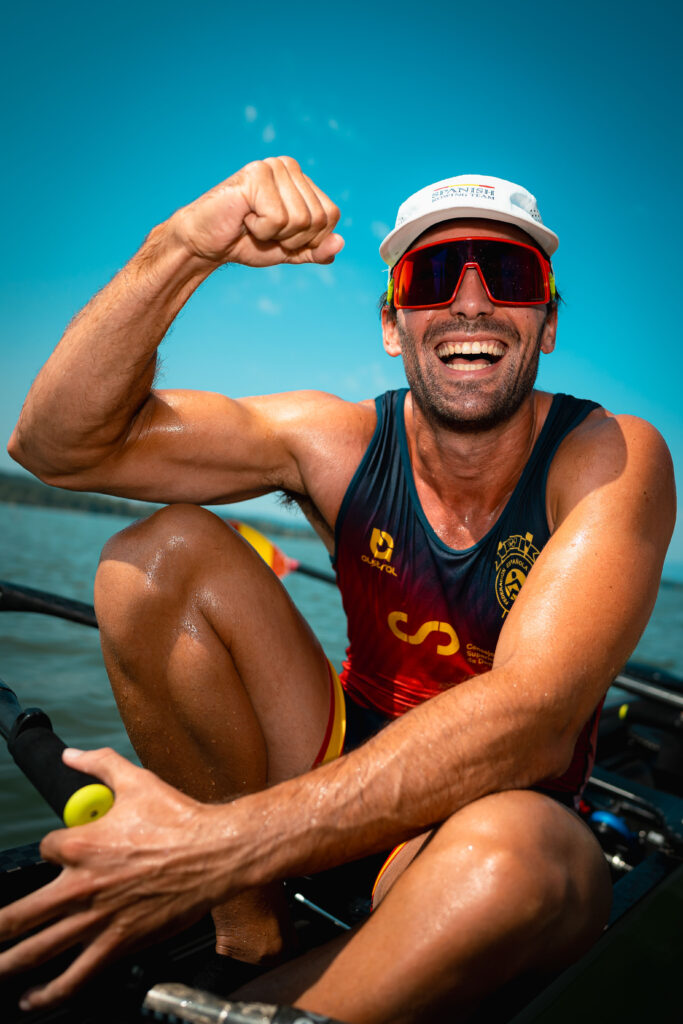
Coastal rowing, and, in turn, beach sprints, developed from the recognition that rowing exists in some form everywhere in the world. Beach sprints were created to make coastal rowing more spectator-friendly.
“We realised pretty early on that coastal’s amazing,” Batten says. “Getting out on those coastal boats, being out on the waves, it’s fantastic. But if you’re in the audience or you’re a fan, the only way to be part of it is to be rowing in it. So how do we take that excitement and get it on to the beach?”
The other aim was to create an event that is easier for different nations to host, while giving plenty of exposure to both athletes and the hosts themselves. Shared boats also keep costs down for participating federations. And Batten adds that from the start making the event fun was important.
“I always dreamt that you walk straight out of the hotel on to the venue and then everyone’s having a massive party on the beach,” she says.

That culture has become part of the sport, with a strong atmosphere of respect, camaraderie and fun.
“We’re presenting a show, and inside that show is great athletes who’ve worked really, really hard. Beach sprints is a massive beach party with world-class sport going on inside it,” adds Batten.
Olympic Impact | Beach Sprints Debut Coming at the LA28 Games
One of the aims of beach sprints’ creation was to make it a discipline that would be included in multisport events around the world, such as the World Beach Games – something which remains a priority – but its addition to the Los Angeles 2028 Olympic programme came about in response to the loss of lightweights from the classic rowing programme. The successful bid to add beach sprints to Los Angeles ensures rowing’s overall athlete quota is unaffected and could open the door for nations to win rowing medals for the first time.
The introduction of beach sprints to the Olympic Games is resulting in more professionalisation of the sport. A number of federations now run funded programmes for pure beach sprint athletes, which is driving up standards and means bigger and bigger teams are travelling to events.
As the discipline has developed, it has also attracted more rowers crossing over from classic rowing, or prompted those who started out in coastal to focus more seriously on a tilt at the Olympics. Beach sprints is now a sport that an elite athlete can pursue full-time. Yet keeping its core values is key.
“If you look at sports that have come into the Games, it does change the personality, and we’re working really hard to make sure that we still have our personality,” Batten says. “That the audience can really go and talk to people, that happiness, the joy, the camaraderie, the respect of each other, we want to keep that because that vibe is really close to the sport.”

Batten emphasises that beach sprints is a spectator sport, and fans should be ready to be an active part of proceedings – or, if watching on TV, that they see the full story of the event unfolding on their screens. That includes showing boat preparation and warm-ups before the non-stop racing through the last eight of an event.
The discipline is also continuing to evolve, with a continued focus on improving that spectator experience. New nations join every year, with nine countries set to debut at the World Rowing Beach Sprint Finals in Qingdao: Colombia, Indonesia, Libya, Malaysia, the Philippines, Somalia, Syria, Tonga, and Uganda.
As beach sprints move into its first-ever Olympic qualification year, Batten says it is crucial for the discipline to be present and visible, and that fans buy tickets to be there at the Los Angeles party. The aim is very much to keep developing the sport beyond 2028, expand the number of participating nations, and be present at future Olympic Games. Make no mistake, the beach party will continue.