02 Nov 2026
Beach Sprints Bring the Noise as China Make Olympic History
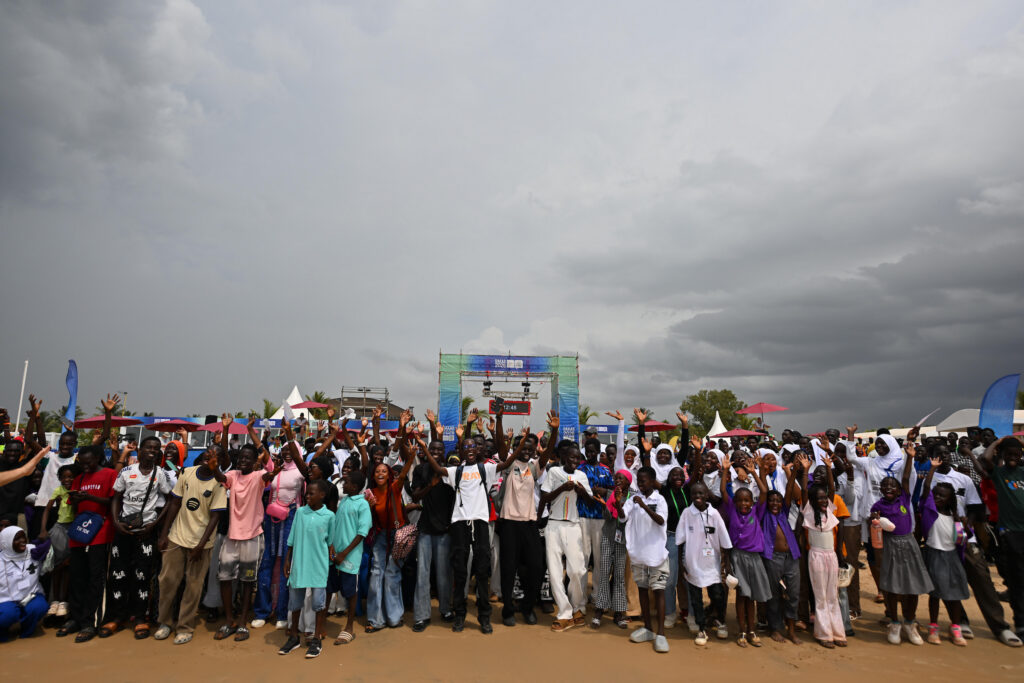
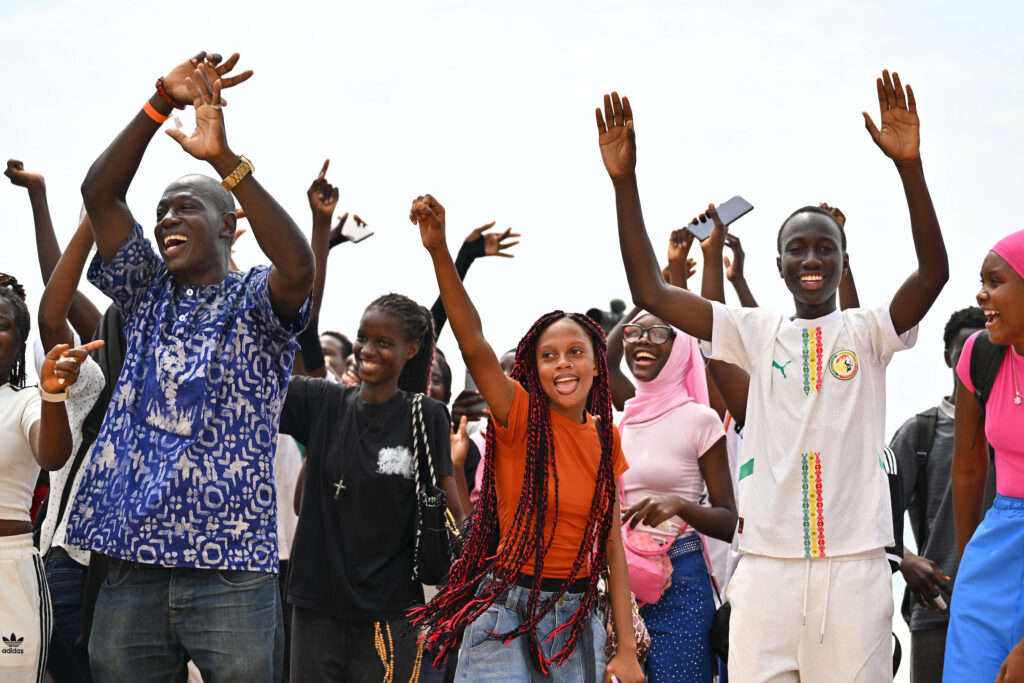
Where flatwater rowing brings the hushed sounds of oarlocks and the sight of rhythm held so evenly that the boat seems to glide along the water, Beach Sprints bring the “Bring da Ruckus” of a grittier Wu-Tang Clan vibe to the scene. On Saly Beach West, with the drums of Senegal rolling in off the Atlantic, the first medal ever awarded in the discipline at an Olympic event was decided in the Mixed Coastal race, as China’s Su Juntao and Liu Lili had both: lungs and legs at the redline, blades still perfectly in time.
Winning Every Race That Mattered | China Makes History with Youth Olympic Gold at Dakar 2026
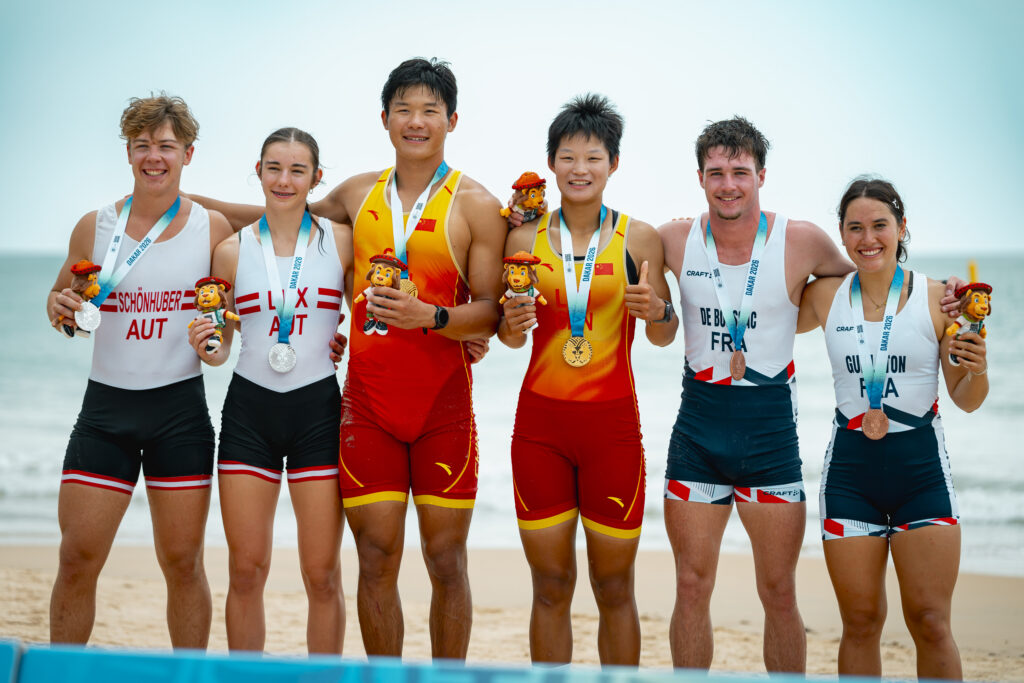
China’s Su Juntao and Liu Lili won the Gold Medal Race in 2:22.37, 6.58 seconds clear of Austria (2:28.95). That completed an unbeaten run through four knockout rounds. They qualified second from Time Trial 1, 1.71 seconds behind Germany, and did not lose a head-to-head race after that. They beat the United States by 7.74 seconds in 2:12.44 in the quarterfinal, the fastest time of the event.
“Both of us are very strong and that gives us an advantage,” said Su. “I had responsibility, and our coach guided our movement well. We saw that they were behind us.”
For Liu, there was plenty of emotion behind that commanding performance: “We are tired because we just came back from the world championship and we didn’t get any rest. I was actually quite nervous before it started.”
Those nerves Liu spoke of seemed to only power the Chinese duo in the gold-medal race!
Austria Go from Last Qualifier to Silver
Austria’s Lucas Schoenhuber and Alena Lux were the lowest-ranked crew to advance from Time Trial 1, finishing eighth in 2:39.80. They beat Egypt, the Time Trial 2 winner, by 2.06 seconds in the Last 16. They then eliminated Germany in the quarterfinals (2:13.54 to 2:15.80) and Ukraine in the semifinals (2:20.31 to 2:24.50). Schoenhuber and Lux put up a valliant row in the Gold Medal match-up against China, but their fairytale run came to an end — but you couldn’t tell. For Austria, silver looked like it tasted just as good as gold.
Germany had led Time Trial 1 in 2:35.86 and posted the fastest Last 16 time (2:13.42). Their run ended in that quarterfinal, 2.26 seconds short.
France Hold off Ukraine for Bronze by 0.65
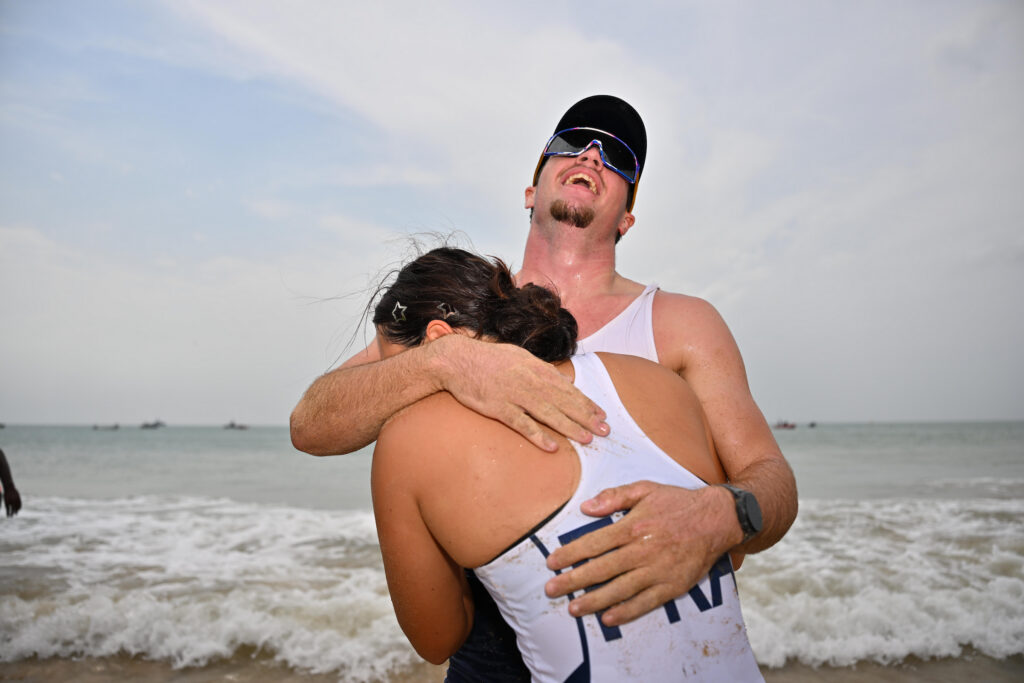
France’s semifinal against China was a struggle. They turned it around in the Bronze Medal Race, beating Ukraine 2:20.20 to 2:20.85. Ukraine had come through a Last 16, where Türkiye finished in 2:43.85, and then beat Czechia by 1.46 seconds in the quarterfinals.
“We’re very happy, so excited. It’s huge,” said de Boussac. “We weren’t the favourites, so to medal is really something.
“It’s a historic first, and it’s an honour that it’s us.”
Times slowed through the afternoon. Quarterfinal winners were between 2:12 and 2:15, while the semifinals and finals ran from 2:20 to 3:01, with an afternoon storm rolling through the competition venue minutes after the victory ceremony.
Solo fields cut to eight as the waves build in Saly
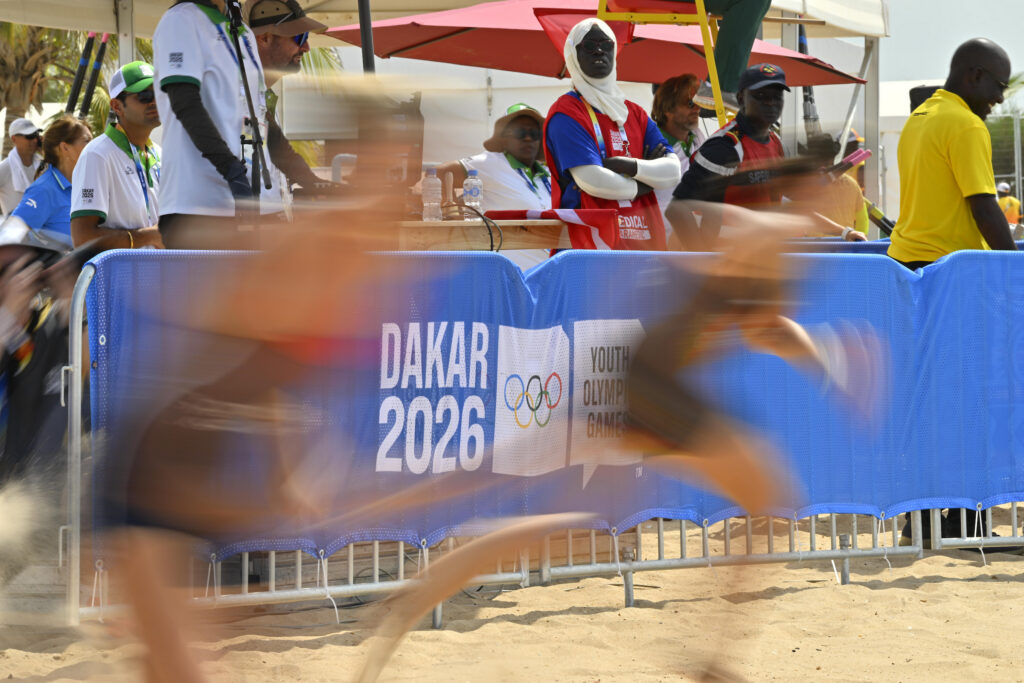
Earlier in the day, the Under 19 Men’s Solo and Under 19 Women’s Solo fields were cut from 16 athletes to eight in the Last 16 knockouts. Wind and waves built through the morning, so athletes were tested on navigation, boat handling and adaptability as much as speed.
De Boussac stuns Time Trial 1 leader
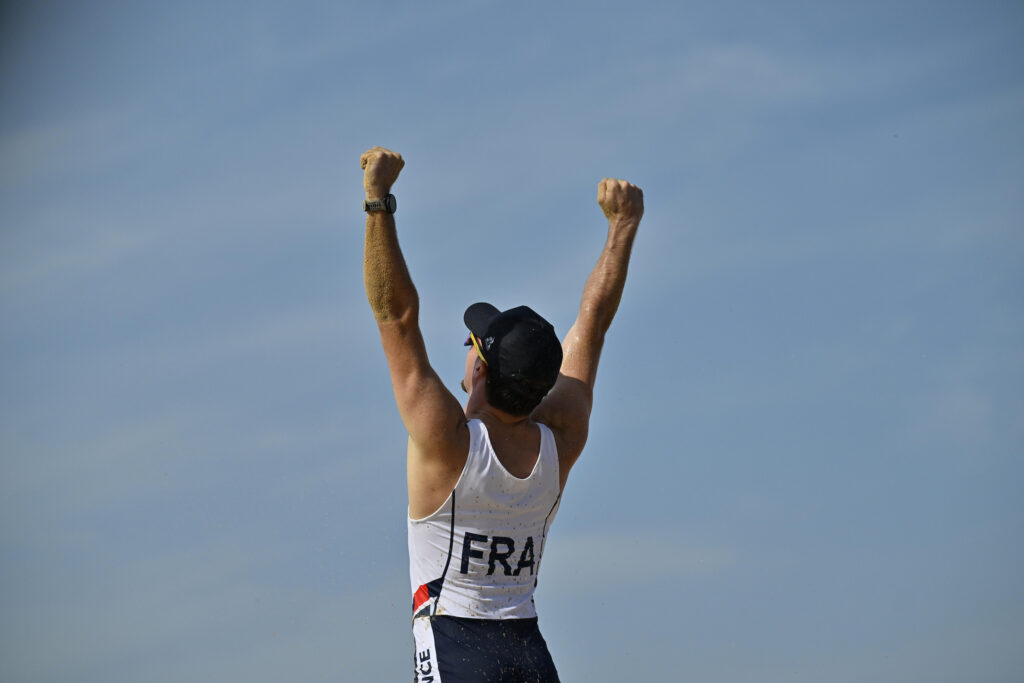
The Men’s Solo Last 16 opened with its biggest upset. France’s Raphael de Boussac eliminated Greece’s Iason Mouselimis, the European U19 Men’s Solo champion and fastest athlete in Time Trial 1. De Boussac was nearly a second quicker on the opening run and extended his lead on the row out. Mouselimis fought back with a quicker turn and moved ahead on the row back, but de Boussac responded one last time, overtaking him in the boat-to-run transition and the sprint up the beach.
Egypt’s Yossuf Moursi also had to come from behind against Mexico’s Enrique Cristiano Morelos Olivares, who was quicker on the opening run. Moursi overtook him on the water and held the lead. Morelos Olivares was upbeat in defeat.
“I think it was a good result. I am happy with the time. I am so proud to be here representing Mexico at the Youth Olympic Games. I am aiming for LA 2028,” he said.
Italy’s Davide Gazzola had one of the round’s more straightforward races, leading Türkiye’s Zihni Senih Alatas from start to finish.
Dreyer Catches a Wave
South Africa’s Callum Dreyer and Lithuania’s Justas Domarkas traded the lead repeatedly. Domarkas was quicker on the opening run, Dreyer moved ahead on the row out, and the Lithuanian had the faster turn. Dreyer pulled back in front on the drag to the beach and won, posting the fastest Men’s Solo Last 16 time of the round (2:19.71).
“Every time I looked over my shoulder, he was right next to me the whole time,” Dreyer said. “Coming in, I thought, my only chance is to try to catch a wave. And so, I was able to catch it, and that gave me an upper hand.”
Czechia’s Ondrej Zizka beat Germany’s Johann Felix Meyer, taking the lead on the run to the boat and building on it through the turn. Both still had Mixed Double Sculls races later in the day, but both ended up outside the medals.
Spain’s Diego Molina Martinez benefited when Ukraine’s Mykola Tomchai, who was faster on the opening run, caught a crab in the first few strokes. The Spaniard stayed in front from there.
Su Fights Back to Edge Runin
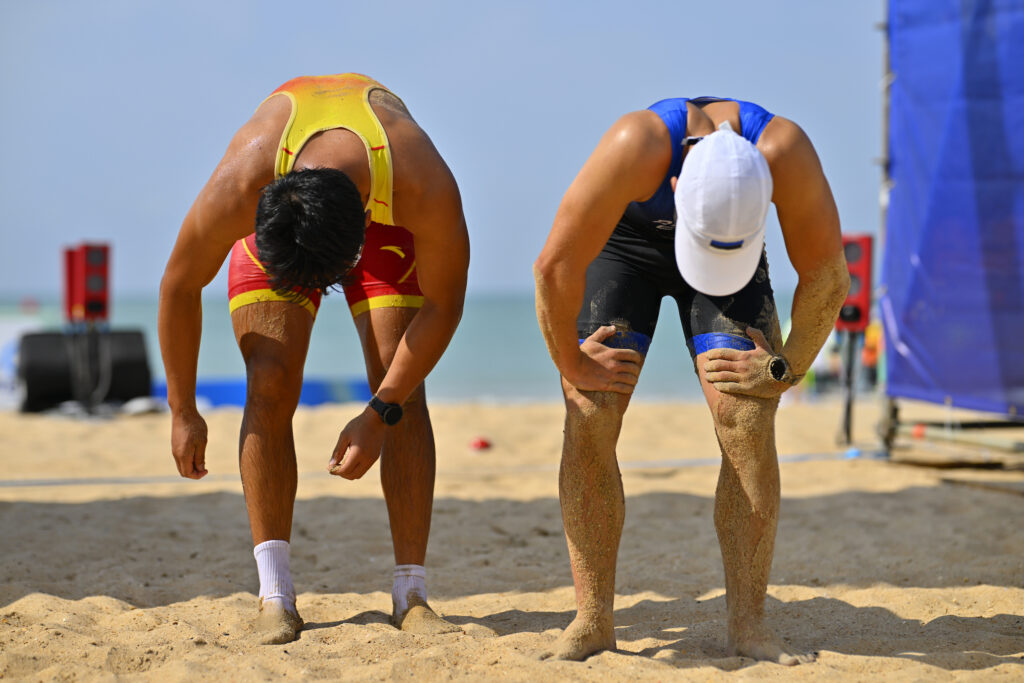
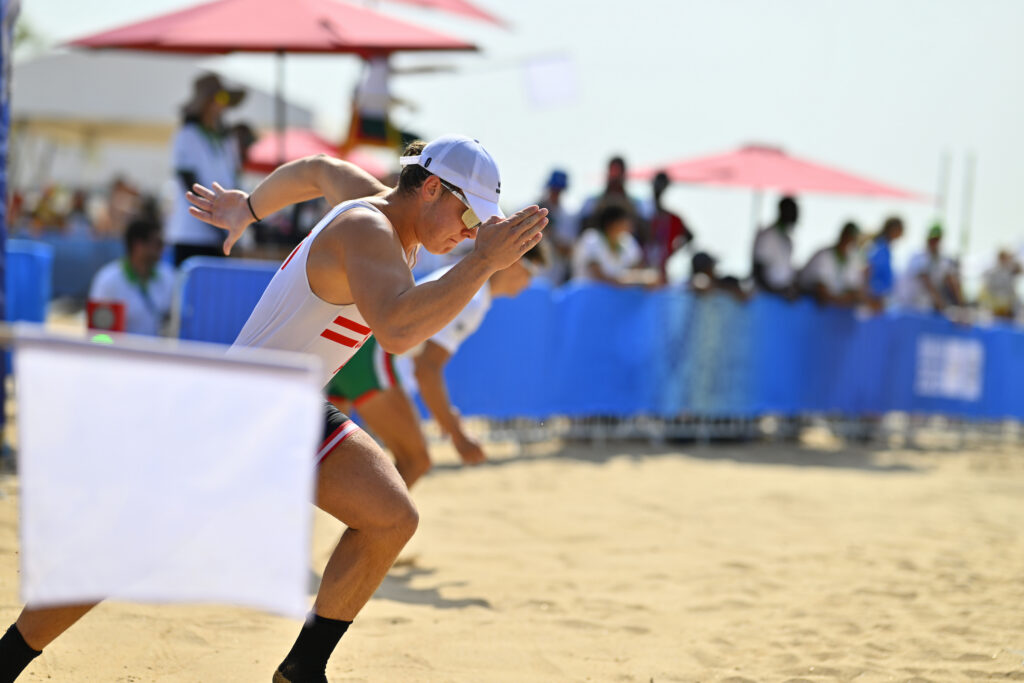
China’s Juntao Su and Estonia’s Steven Runin produced one of the morning’s closest finishes. Runin led on the run, and Su lost ground after hitting the first buoy. Su caught him by the turn, overtook him, and won by less than a second.
Runin said the turn was decisive.
“I messed up on the turn. I kept missing the water while trying to turn 180,” he said. “I don’t think you can go any race in Beach Sprints without some form of mistake. I think when I saw I was in first place, it got to my mind, and I messed up.”
Hungary’s Adam Moor took the final Men’s Solo Last 8 place by beating Austria’s Lukas Schoenhuber. Moor was marginally faster on the opening run and kept his advantage on the water, then extended it on the return to the beach.
The Men’s Solo Last 8 will feature de Boussac, Moursi, Gazzola, Dreyer, Zizka, Molina Martinez, Su and Moor.
Brendle Sets the Tone in the Women’s Solo
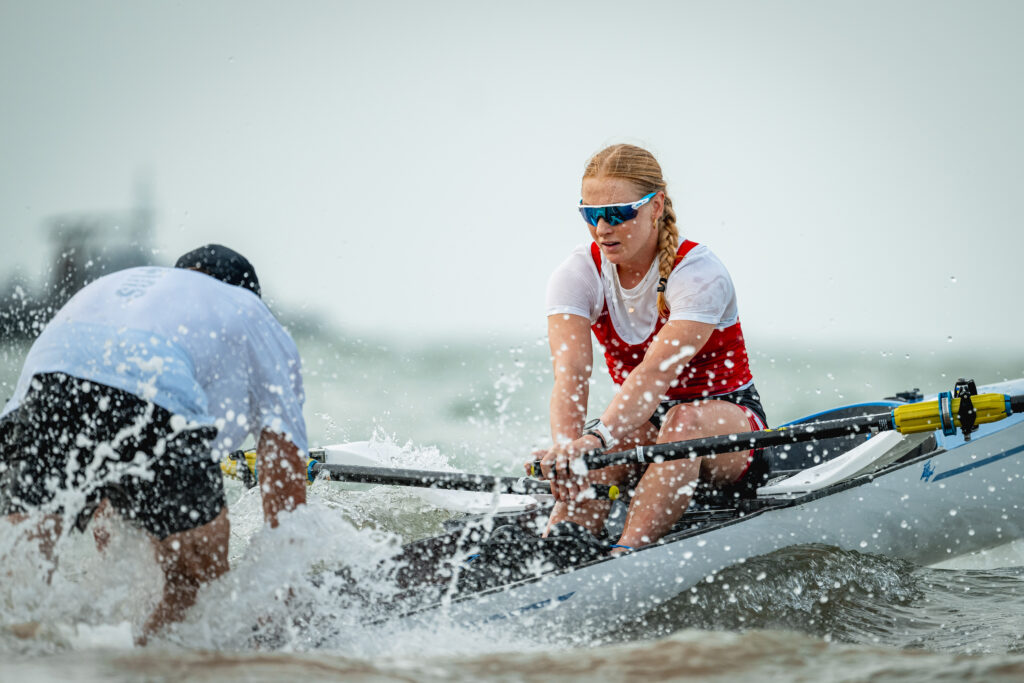
Switzerland’s Tanya Brendle, fastest in Time Trial 1, began the Women’s Solo Last 16 against Ireland’s Kate Dunne. Brendle reached her boat 1.5 seconds ahead and stretched that to six seconds going into the turn. Dunne cut the gap to three seconds with a quick turn, but Brendle pulled clear again and won by seven.
“Some very big waves, it was tricky to manage,” Brendle said. “You really have to know to play with the waves, not be against them, but then also know how to stay on course.”
Looking ahead, she added: “I don’t have any big expectations for tomorrow, but have fun, and see what comes of it.”
China’s Lili Liu led France’s Elisa Guilloton from start to finish, extending her lead after Guilloton had difficulties with her boat. Spain’s Blanca Lopez Valera also controlled Thailand’s Thatchaporn Phengsawang, leading throughout.
Hakala’s Detour Helps Hand Zavadilova the Race
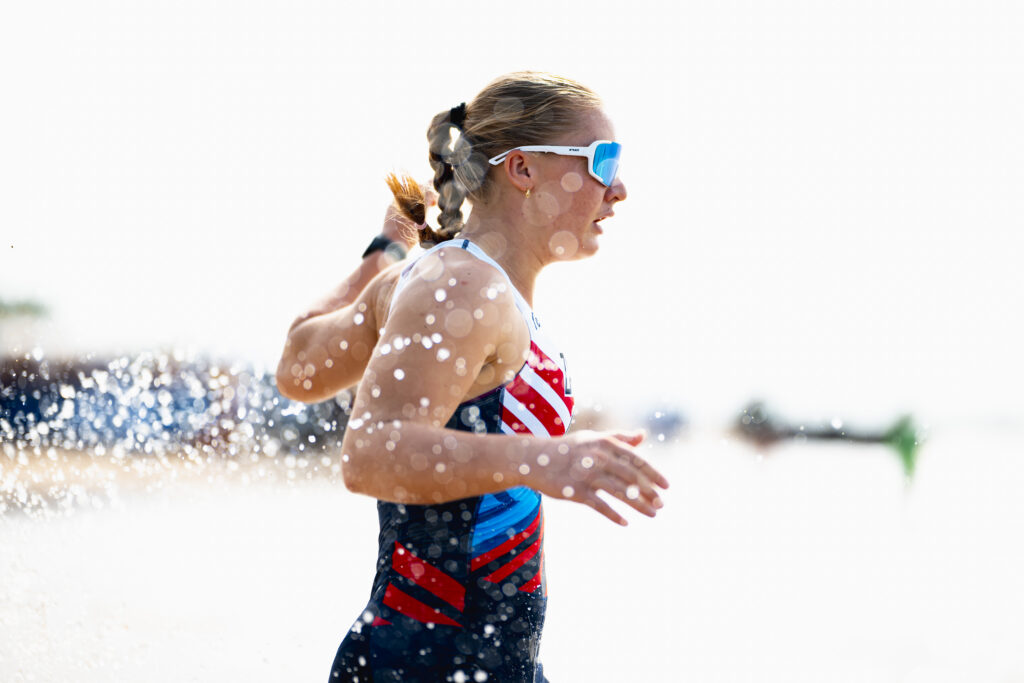
Czechia’s Marie Zavadilova gained an early edge when Finland’s Saaga Hakala ran around the flag to her boat, adding distance to her opening sprint. Zavadilova went on to a comfortable win, with Mixed Double Sculls racing still to come for her later on that day.
“I forgot I can run straight to the boat,” Hakala said. “I was just really happy to make it to the knockouts. I just wanted to go as fast as I can and make it hard for Czechia to go another round. I was in my own bubble and forgot about not going around the flag.”
Hakala also contrasted Dakar with home, where she said it was about –5°C, and noted how the waves and wind were affecting the course.
Griffin Cheered Into the Last 8
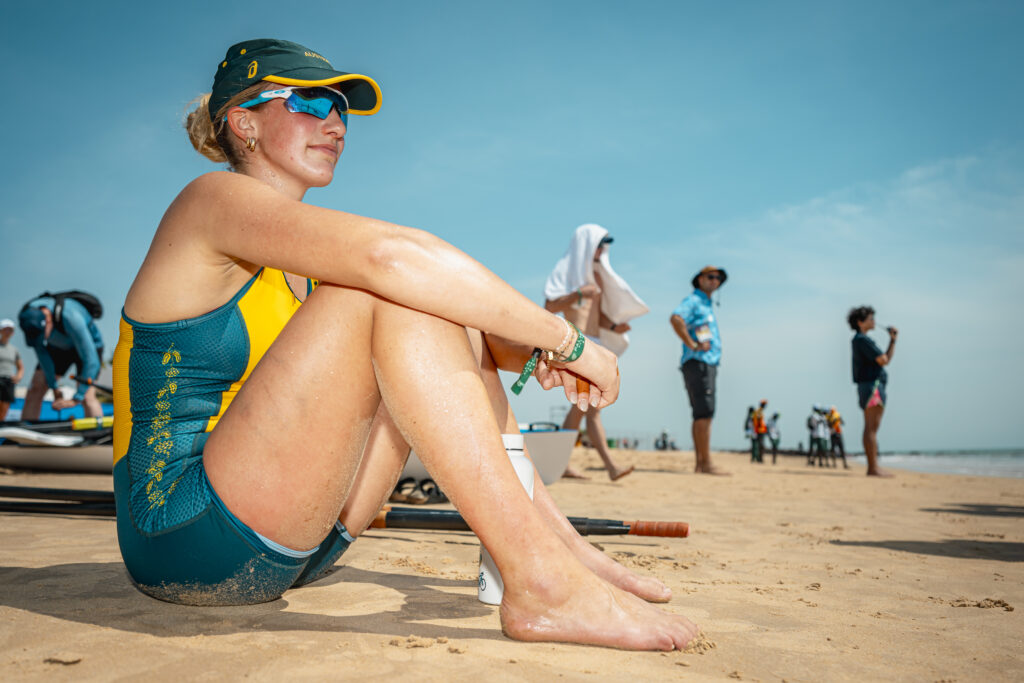
Australia’s Camilla Griffin led Ukraine’s Viktoriia Radchenko throughout, backed by a large and vocal Australian contingent on the beach. She called it “a pretty clean run” despite the growing wind and waves.
“There’s a bit of wind and waves making it difficult to find a good line, but I was able to do my best, find the best line possible,” she said. “Didn’t hit any buoys, which is good.”
Griffin said conditions had changed markedly since training, when the water was considerably flatter. The noise on the beach came from her family, her doubles partner’s family, Australian beach volleyball athletes and team staff.
Lux, Ozdemir and Guerra Gonzalez Complete the Last 8
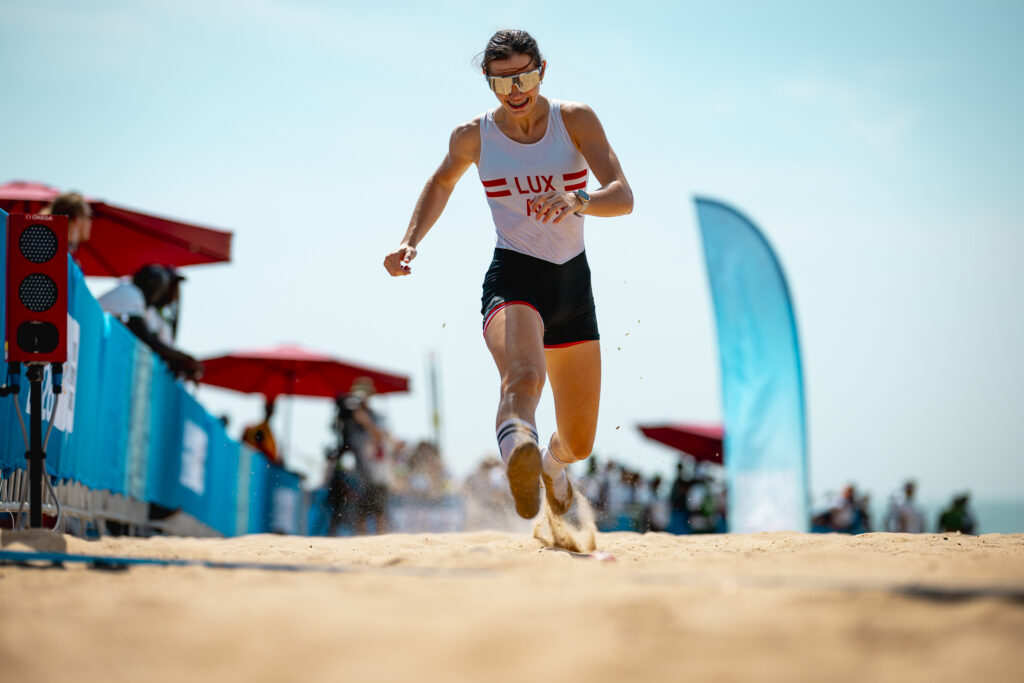
Great Britain’s Lexi Gill reached her boat two seconds ahead of Austria’s Alena Lux, but Lux led by three seconds at the buoy and gained further time through the turn and on the return.
“It was quite difficult to row, but it was enough, and I’m really looking forward to tomorrow,” Lux said. “They’re all extremely strong, but I will go against them, and we will see.”
Türkiye’s Elif Ozdemir led Egypt’s Alia Ali throughout, though Ali kept the pressure on early, and Ozdemir couldn’t open a gap of more than two seconds before the turn. She extended it on the way back and posted the fastest Women’s Solo Last 16 time (2:43.95).
Germany’s Carolina Guerra Gonzalez completed the line-up with a start-to-finish win over the United States’ Allison Grove, the competition’s youngest athlete at 15.
The Women’s Solo Last 8 will feature Brendle, Liu, Lopez Valera, Zavadilova, Griffin, Lux, Ozdemir and Guerra Gonzalez.
Both Solo events resume on Tuesday 3 November, starting with the Last 8 and ending with the coronation of the first Men’s and Women’s Solo medallists in Olympic history.
Parting Shot