


11 Sep 2026
Athletes for Life, Ambassadors for Rowing
After 24 years on the World Rowing Masters Commission, Ronald Chen has seen masters rowing go from a volunteer-run community into a growing global movement. He’s still on a mission to help take it further.

At first glance, Ronald Chen’s professional life and his rowing life might seem to run in different waters.
He is a distinguished professor of law at Rutgers University. He has served as dean and co-dean of Rutgers Law School and spent years in legal advocacy for the American Civil Liberties Union.
But for more than four decades, another constant has remained: Rowing.
Chen first encountered the sport as a teenager at Phillips Exeter Academy in New Hampshire, where he became the rowing team’s student manager. He later held a similar role at Dartmouth College during his university years, then became an international rowing umpire, officiated at the 1996 Olympic Games, and joined the World Rowing Masters Commission in 2003.
Since 2019, he has chaired the commission. At the 2026 World Rowing Congress in Amsterdam, he was reappointed for a final term and is part of the Executive Committee under a new statutory provision designed to strengthen geographical representation, including at least one member from outside Europe.
For Chen, though, the numbers tell only part of the story.
The bigger story is what has happened to masters rowing during those 24 years.
“When I first came onto the commission, we were still doing entries with faxes and yellow pads,” Chen says.
In those first years, Chen helped move the operation onto Excel spreadsheets. At one point, he recalls, he was personally checking as many as 11,000 entries for duplicate names and clubs.
Today, a World Rowing Masters Regatta is a very different proposition.
The scale is enormous. The competition is run to international standards. Sophisticated systems handle age and identity verification, and World Rowing staff are now embedded in organising an event that was once delivered almost entirely by volunteers.
“It has been tremendous growth,” Chen says.
But one thing has not changed: the people.
The Infrastructure Behind the Athletes

Walk around a masters regatta and the first thing that strikes you is the diversity of the athletes.
There are former Olympians and people who discovered rowing later in life. Some have been rowing since childhood, while others returned to the sport after careers and families. Crews compete well into their 70s, 80s, and beyond. As our conversation takes place, an octogenarian comes into the World Rowing office for his “Octos” medal, given out to every rower aged 80+ competing in Bled.
But look a little closer, and another story emerges.
Many of the people running the sport are masters themselves.
They are coaches, club administrators, officials, umpires, organisers and volunteers. They keep clubs operating, create opportunities for young rowers, and turn a collection of boats and races into a functioning rowing community.
Chen knows this from experience.
He became an umpire partly because it gave him a way to stay involved in the sport. Today, he sees thousands of other masters rowers doing much the same thing.
“Without that large group of people working, almost always on a volunteer basis, to promote the sport, rowing would be immeasurably poorer,” he says.
There is also a direct link between the generations.
At the World Rowing Masters Regatta, a contribution from the seat fee goes towards the youth fund. It is a small but symbolic example of something Chen sees throughout rowing: people who benefited from the sport feeling a responsibility to pass those opportunities on.
“The opportunities the sport gave them, they’re able to pass on,” he says.
That sense of responsibility is a defining characteristic of masters rowing.
The athletes may have finished their elite careers, but they have not finished being part of the sport.
In the Rowing Community for Life

Chen’s own route into rowing was environmental.
At 14, he was simply looking for a sport. Exeter happened to have a long rowing tradition, dating back to the 1870s.
His classmate at Exeter was seven-time Head of the Charles winner Anne Marden Grainger, who competed in three Olympics for the United States and won silver medals in quad sculls at LA 1984 and single sculls at the Seoul 1988 Games. Chen continued in rowing as an international umpire.
Although their rowing paths differed, both remained connected to the sport. That may be one of the sport’s defining characteristics. People leave for university. They leave for careers. They start families. They move cities. Sometimes they disappear from rowing for years. And then they come back.

“There are all sorts of different life paths, but they come back to rowing,” Chen says.
That lifelong connection is visible throughout the masters community. And it is changing.
Chen points to the increasing participation of women in masters rowing as one of the most significant developments he has witnessed. The athletes who benefited from the expansion of opportunities for women in American sport decades ago are now becoming an increasingly important part of the masters community.
This year, women make up around 44 percent of the competitors at the World Rowing Masters Regatta. The result is a masters community that is not simply getting older; it is becoming broader.
From Europe and North America to the World

For all its growth, Chen believes masters rowing still has work to do.
Historically, the community has been concentrated in Europe and North America. South America has made significant progress in recent years, and World Rowing held its first Masters Regatta in South Africa three years ago.
In 2029, the World Rowing Masters Regatta will head to Paraguay.
For Chen, these are not simply venue changes.
They are opportunities to build rowing communities and leave something behind.
A major international regatta can provide more than competition. It can give local organisers the experience and knowledge needed to run events at an international level, building expertise they can use again.
That is particularly important in countries where rowing is still developing.
“The more times we leave a legacy — whether it’s physical infrastructure or, in our case more likely, a knowledge base of people who know how to run a regatta like this — the more valuable it becomes,” Chen says.
Asia, he believes, is the next major opportunity.
“There is a very large masters community in Australia,” he says. “Beyond that, there is a community that we know is there in Asia but has not yet become as evident as it might otherwise be.”
For Chen, expanding masters rowing is part of a much bigger ambition: showing how rowing can create a genuinely global community.
A Regatta at Full Capacity

There is, however, a challenge that comes with that growth.
At Bled, the scale of the World Rowing Masters Regatta is almost difficult to comprehend. Thousands of athletes. Thousands of boats. A boat park stretching through a landscape that was never designed to accommodate such a volume of equipment. 3000 boats to be exact.
Chen remembers coming to Bled in 2017 and immediately asking whether the venue could handle the event.
The local organisers found ways to make it work.
But that success raises a difficult question: how big can a masters regatta become before its size starts working against it?
“This model has become so successful, and the last thing we want is for it to become the victim of its own success,” Chen says.
That could mean looking at different models in the future — including stronger regional competitions and more opportunities for national federations to run their own masters events.
The aim would not necessarily be to replace the giant international gathering, but to make sure the growth of masters rowing is sustainable.
For Chen, the challenge is to preserve what makes the event special while finding ways to take the sport further.
A Changing Sport

That same philosophy extends beyond masters rowing.
Chen has watched coastal rowing, beach sprints and indoor rowing develop from emerging disciplines into increasingly important parts of the sport.
He sees them not as threats to classical rowing, but as opportunities.
“If we’re not able to grow and change, then we’re not going to survive as a sport,” he says.
He remembers attending the indoor and virtual World Championships simply because he wanted to see how it worked. What surprised him was how much competition and vitality could be created between athletes separated by thousands of kilometres.
The lesson was clear.
Rowing can evolve without abandoning its traditions.
For masters rowers, that may be particularly important. They are custodians of the sport’s history, but they can also help demonstrate what its future looks like.
Ambassadors for Rowing

Perhaps that is where the significance of masters rowing extends furthest beyond the regatta itself.
Elite athletes arrive at a competition with a very clear mission. They race, they recover, they race again. Their focus is understandably on performance.
Masters athletes experience a competition differently.
They have paid their own way to get there. They compete, but they also visit the town, eat in its restaurants, meet its residents and explore the place they have travelled to.
At Bled, that distinction is particularly visible.
The town is already deeply connected to rowing. But thousands of masters competitors arriving from around the world turn the regatta into something larger than a sporting competition.
“They are, frankly, sports tourists,” Chen says. “They’re paying their own way to come here.”
And that makes them ambassadors.
They carry their experience of rowing into the wider community, just as they carry their experience of the wider world back into rowing.
It is a fitting role for athletes who have spent decades inside the sport.
They may no longer be chasing Olympic selection or national-team places. But they are still competing. They are still volunteering. They are still building clubs. They are still introducing people to rowing.
They are, in every sense, athletes for life.
And increasingly, they are ambassadors for the sport.
The Next Chapter
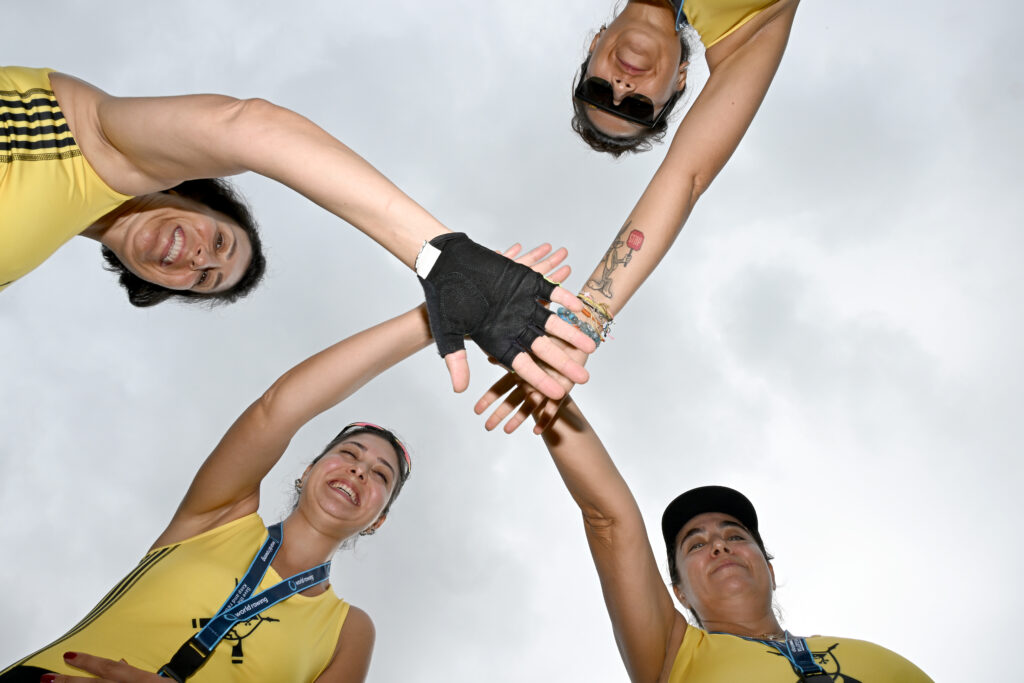
Chen is nearing the end of his time on the Masters Commission. His final term will not be about simply protecting what has already been built.
He wants to see masters rowing expand beyond its traditional heartlands, particularly into Asia and other emerging rowing communities.
After 24 years, his perspective is shaped by both the past and the future.
He remembers the yellow pads and the handwritten entries.
He sees the sophisticated international operation that exists today.
And he knows that behind it all are still people who volunteer their time because they believe rowing is worth building.
That may ultimately be the most important legacy of masters rowing.
The races matter. The records matter. The medals matter.
But the sport survives because people stay.
They return after careers and families. They volunteer. They officiate. They run clubs. They mentor younger athletes. They travel across the world to race — and then tell others why rowing matters.
For Chen, that is the community worth growing.
“The more times we leave a legacy, the more valuable it becomes,” he says.
After a lifetime in rowing, Chen is still thinking about what comes next.