


28 Oct 2026
The new nations making a splash on the beach
Among the more than 50 nations represented at the 2026 World Rowing Beach Sprint Finals in Qingdao, China, were seven competing for the first time in this discipline, and one – Tonga – making its World Rowing debut in any competition.
Supported by the World Rowing development team, along with several other nations, the athletes from Colombia, Indonesia, Libya, Malaysia, the Philippines, Syria, Tonga and Uganda were taking the first strokes on what they hope will be a journey that could see the sport explode on their own shores.
“For me representation is so important. If someone sees someone who looks like them, who sounds like them, who comes from the same country as them doing amazing things, then it inspires them to be able to do it as well,” explains Tasha Mae, one of a team of nine Malaysian athletes who competed in Qingdao.
Beach sprint rowing is a fairly new discipline, and most of the rowers from the debut nations are also new to the sport. But they share a determination to progress and all are eyeing up the possibility of a qualification spot for the Los Angeles 2028 Olympic Games.
“Big potential” in Colombia
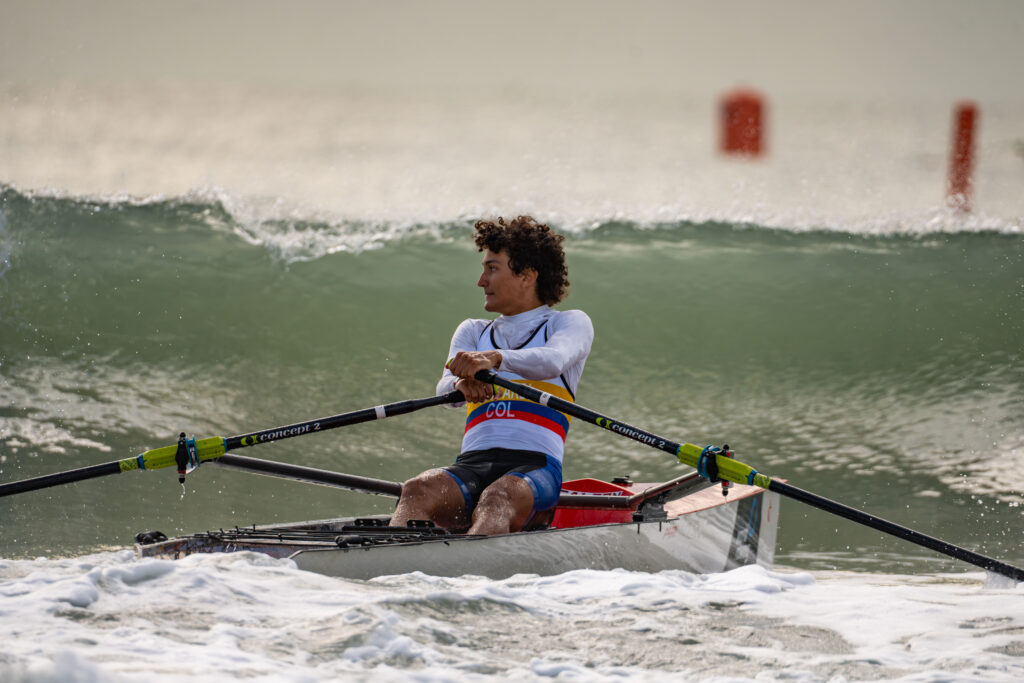
Colombia’s first beach sprint athlete is Alejandro Riccardi, who raced in the junior men’s coastal solo in Qingdao and made the knockout round. Riccardi is half-Italian and began rowing on a casual basis at Canottieri Firenze, although he quit to take up other sports and has since moved to the Colombian city of Cartagena on the Caribbean coast.
Riccardi’s father Davide, a former Italian national rower, got him into beach sprints, but the journey to Qingdao started with lots of indoor training, “suffering every time,” says Riccardi.
He now has several teammates at his club in Cartagena, whose focus is on coastal rowing, and Colombia has been represented at races including the 2026 Copa America in Lima in April this year.
“With my teammates it was more interesting, more fun. All the races with them are very fun,” says Riccardi.
He says there is lots of potential for beach sprints in Cartagena; the city has both open coastlines and a large bay, giving it plenty of space for coastal rowing.
“We need the people to start seeing this sport like an opportunity to represent their country, to stay in form and to do something they like,” Riccardi says.
Putting Malaysia on the map
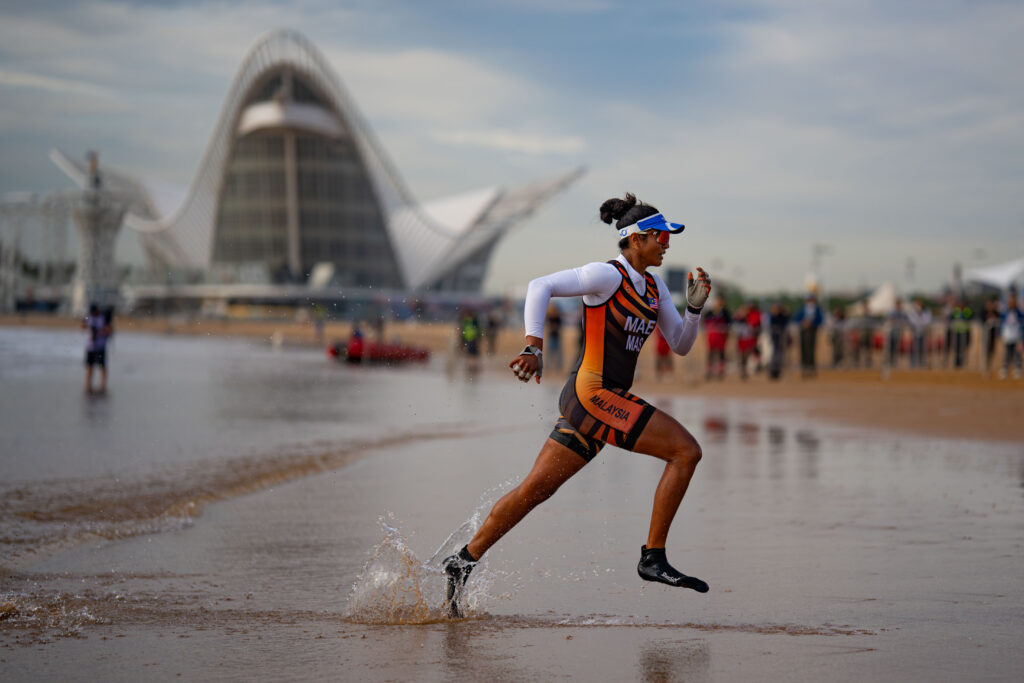
Like her friend Devi Lockwood of Syria, Qingdao was Tasha Mae’s second world championships of the year – both raced at the 2026 World Rowing Championships in Amsterdam.
Mae represented Malaysia at the 2025 South East Asian Games in beach volleyball, but she realised logistically making her dream of progressing further in the sport was a challenge.
“I’m still studying in the US and I’m based there, and for beach volleyball you need to find a partner, you need to train together, you need to compete at events. So I quickly realised that although that was my dream it was a little unrealistic,” she explains.
Supporting a friend who had got into rowing was Mae’s introduction to the sport. After helping with some filming at a talent camp run by US coastal head coach Marc Oria, she decided to switch, taking up rowing in January.
“It’s been the best decision I’ve made in my life. I’m surprised about how many experiences I got to experience in rowing. I went from zero world championships to being able to represent Malaysia in two world championships this year, and rowing has opened so many doors for me,” Mae says.
“The community is amazing. Even though I’m so new, everyone has just been nothing but encouraging and welcoming. Every limiting belief I had in volleyball has completely gone out of the window and I’m just starting anew with such a different approach.”
She is excited too about the prospects for beach sprints in Malaysia.
“We’re a peninsula, so we have tons of beaches, and the island culture is pretty much embedded in us. So if we can get something proper going on, if we could get some training centres, I think this is a sport we could excel in in the future.
“Hopefully through joining these regattas, competing internationally, people start to hear about it, create some buzz and some hype, and hopefully it piques people’s interest.”
The start of Syrian rowing
Mae’s friend Devi Lockwood is also based in the USA, and also picked up beach sprints with Oria’s Next Level Rowing project after previously rowing at university. When she raced at the Copa America in April she became Syria’s first-ever international rower.
Syria underwent regime change in late 2024 and is in a transitional period politically. Lockwood says this also means there is “a lot of positive energy” in Syrian society.
“When I decided to get back into training and pursue this dream it’s really not about myself but about creating pathways for Syrian people to be able to row and compete,” she says.
“It’s not something that’s really a big part of the culture right now, but rowing’s changed my life for the better in so many ways, and I think coastal rowing especially is so accessible, so I just want to make those opportunities available for as many people as possible.”
Lockwood adds that her journey in beach sprints so far has been helped along by the likes of Oria and also other national federations.
“Neighbouring countries have been so kind to me when I show up at events and it’s just me, or me and a small delegation just trying to learn this for the first time,” she says. “That kind of collaboration is so essential.”
Cooperation and adaptability have been key in Lockwood’s beach sprint journey so far.
“It’s an aspect of the sport that really has taught me about the importance of just really occupying the moment and being wherever my feet are planted and doing the best I can with the resources I have,” she adds.
The Syrian Ministry of Sport and Youth have been supportive of Lockwood’s efforts, and she says rowers and potential rowers across the Syrian diaspora are reaching out with interest. Getting rowing on the ground in Syria is the next step: there are no ergometers, boats or oars there right now.
“What we need help with more than anything else is equipment. Once we have that we’ll be unstoppable,” Lockwood concludes.
Halafi making Tongan history
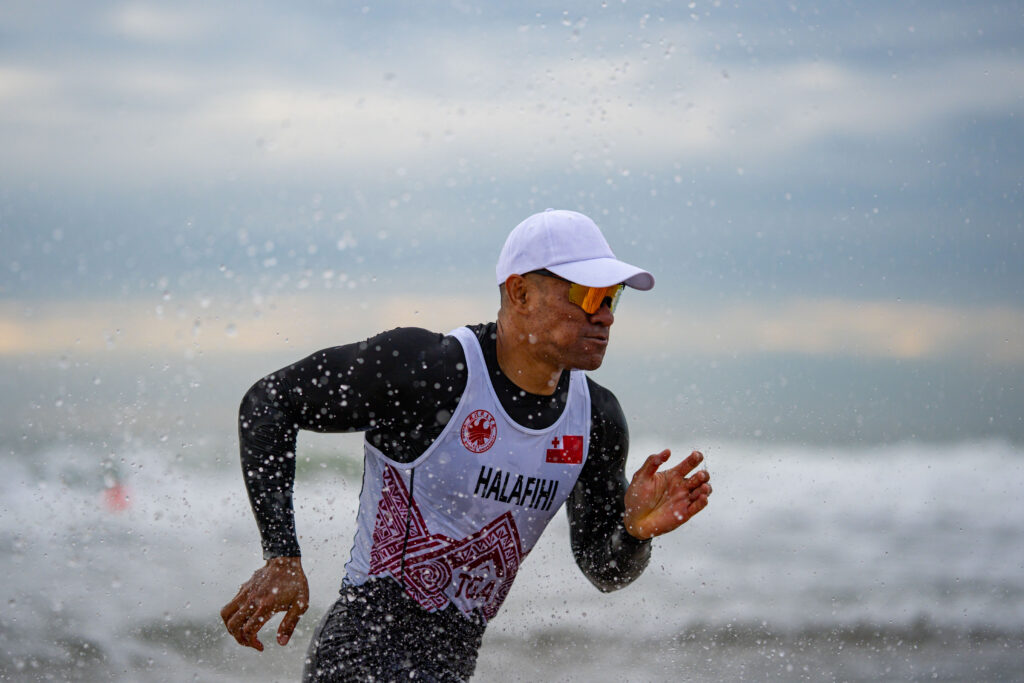
Tonga’s Kava Halafi started indoor rowing in December last year, single sculling in May, and Friday’s training session in Qingdao was his first time in a coastal boat. His family back in the Pacific were not even aware he is due to compete at the World Rowing Beach Sprint Finals, as Halafi says: “I didn’t want to put too much pressure on myself.”
Halafi is actually based in China, having come to the country aged 15 on a scholarship to train in taekwondo. But he has stayed put and is currently pursuing a doctorate at the Wuhan Sports University.
Although Halafi is new to rowing, he says the sport makes sense for him; he has also played several ball sports, including rugby, and done track sprinting, but knee surgery has now ruled those out.
“Just my body type, and being an islander, always on the beach from a young age, I think I have the feeling of the water,” he explains.
The Tonga Rowing Association is a couple of years old, and Halafi is the first to put the island nation on the international map. He hopes not to be the last.
“I’m trying to open more doors for the next generation of them, and be an inspiration for the kids. As islanders, being Polynesian, I think we’re meant to be rowers and hopefully I can open more doors for them,” he says.
Pushing on for Uganda
Uganda’s Elijah Namunyu rowed for a short time as a junior, but came back to the sport more recently, driven by his love of water. Advice from his coach led him to beach sprints, to take advantage of Namunyu’s shorter stature.
After experiencing the Qingdao surf for the first time, Namunyu says: “I was a little bit tense, but keeping on moving it was much better. I was getting through the waves.”
Although he is Uganda’s first beach sprint rower on the world stage, the nation has already had an Olympian; Kathleen Noble raced the women’s single sculls at the Tokyo and Paris Olympic Games. Noble and Namunyu raced together in the mixed double at last year’s Commonwealth Rowing Association Beach Sprint Championships.
While Uganda does have boats, it still lacks a boathouse to keep them in.
“For Uganda to grow, we are still trying to get where to train from exactly. We haven’t yet got the place, that’s the big problem that we have. We need to train on water.
“All the times I’ve been training I’ve been training on the indoor machine, to keep up working on technique. Even though I have power, technique is the key. So we’ve been trying to see how I can improve my technique so I can bring it on water and see how I can maintain it,” Namunyu explains.
He is determined to keep on pushing forward.
“My goal is qualifying for the Olympics. Even to come here I’ve come to see where I am now; even not to stop at the Olympics, but to keep on going, showing that the young athletes in Africa that this thing can take us far,” Namunyu says.